With special guest, Chéla Gage
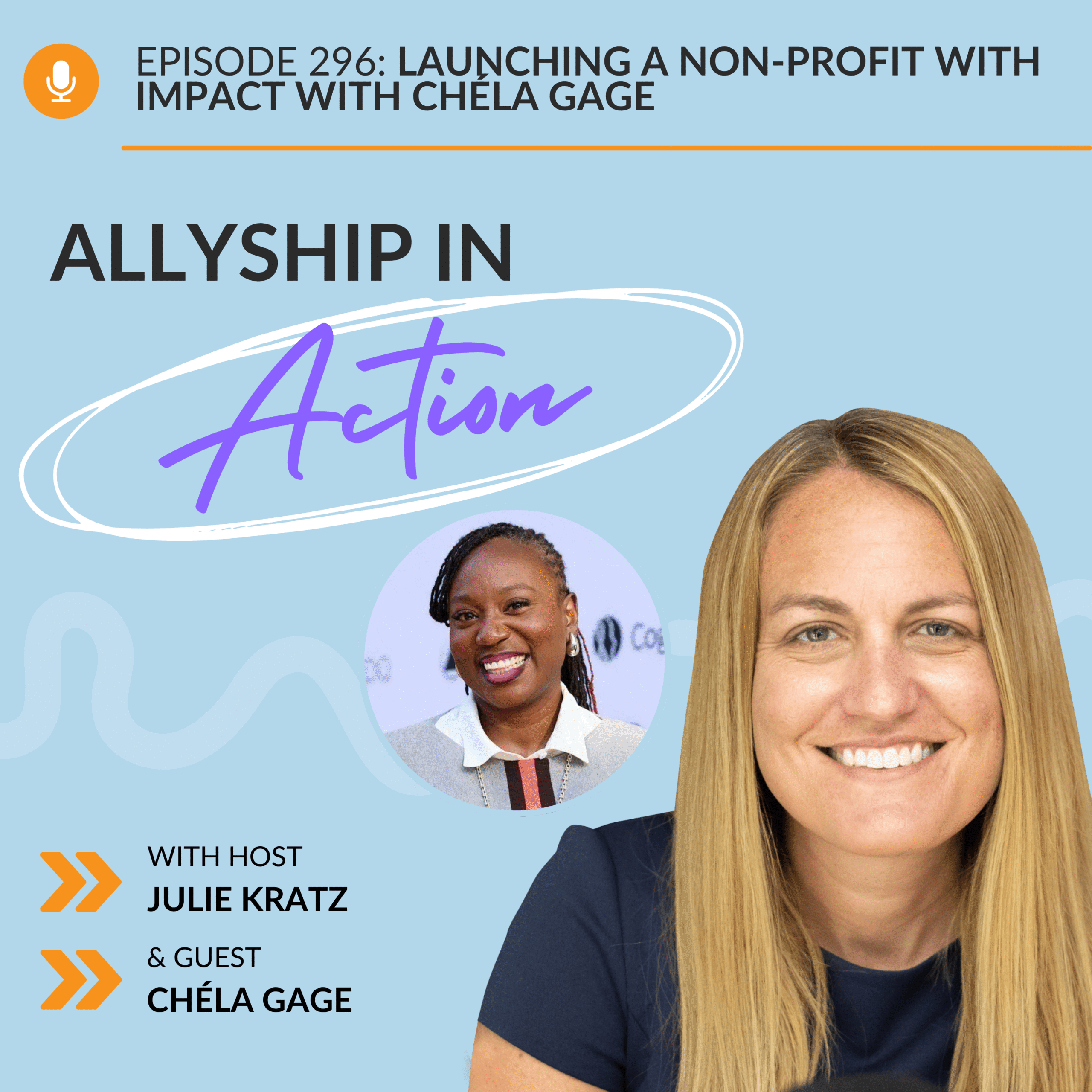
Chéla Gage, a seasoned professional with 25 years of corporate experience at companies like Nissan and Starbucks, joins the Allyship in Action podcast to discuss her latest venture: the nonprofit 1,000,000 Fosters. Chéla also shares her insights on the challenges and rewards of launching a 501(c)(3), her vision for the future, including creating masterclasses and connecting fosters with career opportunities, and the importance of sharing personal stories to inspire others.
Listen Now:


Launching a 501(c)(3) non-profit, and a vision for the future
This week on the Allyship in Action Podcast, Julie Kratz is joined by Chéla Gage returns to learn about her new non-profit 1,000,000 Fosters. Chéla shares her journey and the impact she hopes to create in this week’s episode.
Chéla is a seasoned professional with 25 years of corporate experience at companies like Nissan and Starbucks, joins the Allyship in Action podcast to discuss her latest venture: the nonprofit 1,000,000 Fosters. Drawing from her own experiences growing up in foster care, she is dedicated to empowering adults who have navigated the foster care system.
Key takeaways from this conversation:
- Chéla’s journey to launching her nonprofit to support adults who have experienced foster care as youth. This initiative aims to provide transformative life and career coaching, foster personal growth and independence, and build a strong community for former foster youth. Chéla’s personal experience growing up in foster care fuels her passion for this work, and she envisions the organization as a supportive network, similar to a fraternity or sorority, connecting individuals with resources and opportunities.
- The goal of 1,000,000 Fosters is to empower former foster youth by leveraging their inherent resilience and providing mentorship and guidance. Chéla emphasizes the unique strengths developed through the foster care experience, such as independence, resilience, and adaptability. She plans to create masterclasses led by her network of professionals to offer support in areas like resume writing, storytelling, and navigating adulthood. Ultimately, she hopes to connect this talent pool with corporate sponsors, recognizing the valuable skills and perspectives these individuals bring to the workforce.
- Chéla was inspired to start 1,000,000 Fosters by her desire to make a significant impact and by the powerful stories of connection and empowerment within the foster care community. A pivotal moment was an early podcast interview where a guest expressed the profound impact of sharing his story. This reinforced her belief in the importance of providing a platform for these voices and creating a sense of belonging. Despite the challenges of starting a nonprofit, including navigating the 501(c)(3) process, her determination and the encouragement from her advisors propelled her forward to create this much-needed support system.
Actionable Allyship Takeaway:
Actively seek out and support the talent within underserved communities. Chéla envisions creating a talent database to connect employers with individuals who have experienced foster care, highlighting the unique strengths and resilience of this group. Chéla puts out a call to action for businesses and organizations to become allies by tapping into the potential of often-overlooked populations.
You can find Chéla and learn more about 1 Million Fosters online here: https://www.1millionfosters.com/
Find Julie Kratz at https://www.nextpivotpoint.com/
Read more about this topic and our interview in Forbes.
Full Episode Transcript Available Here
Speaker 1
Hey listeners, I’m so excited to have a repeat guest back on the podcast and talking about something, a new project. So we have with us. Chéla Gage Chéla has done a bunch of corporate DIY roles at big brand companies and has now launched her own business focused on HR, Consulting and executive. Coaching and is here to talk about her new nonprofit, which I’m so excited about. She’s also a podcast host. Chéla is just amazing. Chéla, welcome back.
Speaker 2
Julie, thank you for having me. I’m so excited. That must mean that we’re OK to have these conversations. If I’m a repeat guest, right? Yeah.
Speaker 1
Yes, you might win like a three time guest, always dropping amazing knowledge. So there’s if you haven’t checked out past episodes, definitely go back to those. But we have a whole different subject.
Speaker 2
OK, cool.
Speaker 1
Today, not so much corporate TDI, but your new nonprofit that you’ve launched. So I’d love Chéla, tell our listeners about your new venture, like why you started it. Like all the good things.
Speaker 2
Yeah, yeah. So let me give just a little bit of background. My corporate experience is about 25 years deep and I’ve worked for companies like Nissan, Raytheon, JSU and Cupertino. I just ended my role at. Chief diversity officer for Starbucks. And throughout all of that, what has over the past 25 years, what has given me like? Passion and joy has been connecting my work with my personal background and so personally I grew up in foster care between the age of 7 to 17, I lived in six different. Bones and in four different group homes. Pretty traumatic. I moved around every 10 months or so and it was pretty disruptive because my birth mother lives with schizophrenia and so there were times where. The system thought she was appropriate to take us back so we would go back and live with her and then she wouldn’t take her medicine and we would go. Back into the system. And throughout my experience in foster care, living in different homes, being with different families, I’ve had to be a chameleon. And that chameleon like it’s it’s also helped me in my career. There’s also I’ve with all the negatives or the stigma with being a foster youth. What I know was the independence that I was taught, the resilience that I formed helped create the person that I am today. But also with that I’ve had, I I I’m not the person I am without the experiences that have helped shape me as well. And so I have leaders who really invested in me and kind of like mentored me throughout my career. And not mentorship has meant more to me than anything, because growing up in foster care, it’s not like. It’s not like I knew what corporate America nobody said. And. Here’s how you accept feedback from your leader or no one said. Here’s what happens in the layoff. Or you know, like you, you you just that.
Speaker 1
Automated change and uncertainty.
Speaker 2
Yeah, that doesn’t happen. And so these mentors helped me maneuver life as an adult, and it it somehow connected. My resiliency and foster youth with my career in HR and so recently after ending my role at Starbucks, I wanted to really make an impact in the world because at Starbucks it was 430,000 employees and I thought. If I could impact 430,000 like the ripple effect of that is what brings me joy. And so I wanted to launch something that felt that I felt personally connected to and qualify. Died. To be in the space, and so I’ve launched 1,000,000 fosters and it is my initiative to meet, mentor and build community with adults who’ve experienced foster care as youth.
Speaker 1
That’s so cool. That’s so cool. What I love about the name is the impact is right inside it. So tell us more about the. Impact you hope to create and how you landed on that.
Speaker 2
Yes, so. In the United States, at any point and the data goes back from 2005, it like. There’s anywhere between 350,000 to 300,000. Individuals in foster care, and so our mission is to empower adults who experience foster care by providing transformative life and career coaching, fostering personal growth, independence, and long term well-being. Thing. I envision a world where every former foster youth thrives with confident support and opportunity equipped to lead empowered, fulfilling lives. My purpose is to build a strong community for former foster youth by offering coaching and guidance and connecting them, helping them navigate adulthood and live their fullest potential. I believe I I know for a fact that growing up in foster care like there’s this stigma. Yeah. Well, let me speak from experience. I had the personal shame that no one loved me enough. To seek me out and care for me as an individual. I was provided by the state. I was provided places to live and food. Maybe not the most emotional support. And transitioning into adulthood was really difficult. And I see that as I work with former fosters today, there’s so much. Connectedness that we have in our experiences, I believe that 1,000,000 fosters can be kind of like a fraternity or sorority of sorts, right? Like I want us all to opt in and. For us to be a community that supports each other, for example, business owners that are hiring for talent, if you’re a former foster business owner, nonprofit leader, I want you to come to 1,000,000 Fosters 1st and see what talent do we have that can help your organization. And. I’m not charging for that. I’m just providing the resumes and the resources I want to connect them be the bridge that helps people get from where they are to where they want to be.
Speaker 1
And did you decide on the 1,000,000 part?
Speaker 2
Yes. So there’s this organization that has helped me see the power of my voice, and they’re called the million person project. I did training with them on how to tell my story and I didn’t get this training until I was deep in my third. These and I realized that their their goal of touching a million people was exactly what I wanted to do. I wanted to touch a million people. And I want that to go beyond me because. It’s like there’s great, there’s, there’s so much greatness in community. And so I believe the numbers are there. And if we even look at it globally, someone was telling me, Che, you’re going to hit a million like soon? I know because there’s so many of us who’ve had this experience and don’t know. How to share it in a way that allows us ownership of our story and so. I also want people to feel like they are a part of a community, so the 1,000,000 kind of attaches on to that.
Speaker 1
Yeah, that’s so cool. I love that. I love that. And anything that I love most about your story, as I always do, is just. Your courage and your confidence and your conviction and everything you do, and I think right now, when the world is it’s hard like there’s so much chaos and just so much uncertainty and quite frankly hatred. And you’ve chosen this time to launch something purposeful. And I think what our listeners readers can learn from is just, you know, even though it never, it never feels like the right time to start it or do something like this. But the world really needs this kind of work now and.
Speaker 2
Or yeah.
Speaker 1
So I’m curious. You know, kind of, if you could give us a maybe behind the scenes look into how do you take this from like an idea to like all the way to a 5013 C?
Speaker 2
Yeah. Yeah, so. So. I have the. I guess something about me is I started my career as an executive recruiter and as a recruiter, you. You seek out the best skilled individuals for their niche, right? And so I’ve. Over the past 25 years, I’ve garnered a board of people who I call on for advice and for for, for Council and. At the beginning of the year in January. As we transitioned from 1 presidential administration to the next and the shift in diversity, equity and inclusion is real, like it’s a shift. I was trying to figure out. I was trying to keep my balance in the world and trying to figure out. How can I continue to make an impact even if we change how we do diversity, equity and inclusion? And if I make an impact, where do I? How do I do this? And so my board of advisors recommended that I dig into. I dig into what makes me me. What makes me unique and what makes me qualified and? And. The all of the conversations that I’ve ever had with former Fosters, we talk about it kind of like under our breath. It’s kind of like, yeah, I was in foster care too, but I want us to say it like I want us to beat our chest and I want us to say it loud and proud and. And so my advisors were like change. If you have a hard time saying it, how do you feel? How do you think people who may not have the training, the resources, the skills that you’ve developed? How can they say it? And so my want is to put this lived experience. In a format, a framework that allows other people to do the same thing. What I realize is during Buca, because we’re Luca right now and during Buca time. For me, I lean on community and. What I realized was. If if I need this if if I need this, I’m not the only one. There are others that need this too, and I had a conversation with a gentleman my first podcast interview and this this is where I know I was doing it right and I can’t wait for the world to hear this podcast. When when I started 1,000,000 fosters, I didn’t think I was going to start it. As a 501C3, I just wanted to capture the voices and the stories of those who experienced foster care because there’s so much power and resiliency and so much learning for those of for those who. Haven’t experienced foster care. You can listen to the stories of those who have and be inspired. So I wanted to share that inspiration. After my first podcast interview, the gentleman said thank you for this conversation. I didn’t realize how much I needed to talk this through and I don’t hear our stories very often. Julie, like that, that gives me goosebumps. And it’s what I go to bed with every night that. If he felt. Oh. Empowered by speaking, imagine the empower empowerment people will hear by hearing, and so his words and the voice of my counsel, kind of like merged into one of saying there’s a greater need in the in the world. For people to hear and have this story starting, A501C3 is not easy. I did it so much like Googling and talking, and I sit on the board of a nonprofit organization. Called one mind and they help these stigmatize brain health. They’ve been in business for 30 years as a nonprofit and are still figuring things out. And I’m a part of a board that has about 19 people on it. Talented, still like. So when I thought of how can I start a board like who do I go to? What do I do? It was overwhelming. But what I realized was important, that Advisory Council that I had. Why not go to them, ask, ask them, like, utilize their skills and their niches to help create your board. And then the paperwork for if I want see, there are so many organizations out there that will help you for free. Get your 501C3 because nonprofits really do add value to the community to the impacted. And underserved. And I thought if I want to make an impact, actually someone challenged me and said, and, oh, I love the challenge. Julie, like, don’t tell me I can’t do something.
Speaker 1
I know that’s like pure for you.
Speaker 2
Right. Woo, it’s power. So someone said I wasn’t doing it because it was too hard. Ah. That that wasn’t it. Let me show you what I can do. And so that gave me the that fueled my my want to make a nonprofit. That was for the individuals that I’m serving.
Speaker 1
Yeah. Uh. I love that. And you’re right, there’s nothing easy about starting at 513 C as someone that’s done it myself. It’s. But it’s so purposeful, like especially right now when we need some grounding to center on and with all the DI push back, it seems super smart to focus on like a lived experience. Like you experienced foster care. And that could happen to. All races genders, right? Like it’s a very diverse group that it affects and of course and historically marginalized groups more so. So it just feels like deeply connected to the corporate work you’ve been doing. And to your point about like the boards you’ve been in, organizations you’ve been a part of, you’ve kind of been a student and so you get to learn they’re doing, they can take those lessons learned over to your own nonprofit as you think about 1,000,000.
Speaker 2
Yes.
Speaker 1
Posters and you know, it’s kind of just rubbing up right now. Like what do you envision in the future like, what are the kind of projects, what kind of impacts you’re hoping to create?
Speaker 2
Yes, so. Our key concept is coaching and using their resilience to help them see. How they can get from get unstuck get from where they are to where they want to be and be it transitioning into adulthood, be it transitioning to an executive career right now, the Fosters that I’m working with age and range. Range in age from 18 to 42, so there’s around the cabinet. What I see in the next six months to a year, I see us creating this community where it it’s not all on Shayla. I’m I’m coaching, but they’re reaching out to each other. For support my network when I reached out to my network via personal or social on LinkedIn and I said here’s what I’m doing, the 1,000,000 fosters so many people from my network raised their hands and said Chad, this is so good. How can I help? How can? To help. And so I’m going to lean on my network to create master classes and use their niches to be sneezed in. Something that benefits those who are part of the million foster community, be it resume writing or learning how to tell your story or. Or transitioning into parenthood. So I see that happening over the next six to six months to a year what I. See as success with corporate sponsorship. I see us being a database of talent for corporate sponsors. And look, imagine if you’re an organization and I imagine a retail because a lot of US graduate at the age of 18 and retail is an amazing. You know Ave. to build your career it’s it’s entry level. So I imagine retailers coming to 1,000,000 fosters and saying hey, we’ve got 4 positions open in Colorado, 3 in Texas and. And here we are providing our resumes as resources because. The skill set of being a foster is so unique to that individual, and there’s so much there. There’s independence, there’s resiliency, there’s strength, there’s confidence, there’s. There is. There is. Leaning on community, there’s collaboration. There’s being a chameleon and all of this can be used in the positive when you are an employee and then imagine coming to you as an employer coming to 1,000,000 fosters getting talent. That is not only ready to work, but they’ve also been coached by a professional. Quote so they take in their learning of being coached and then it combined it with their lived experience to bring so much more value as an employee like. That just gives me goosebumps.
Speaker 1
I love it. I love it. Your energy is always contagious, but it’s especially so for this cause, and I agree. I mean it’s it’s it’s not the same, but it kind of reminds me of what programs that are focused. And like neurodivergence, in the workplace rate is extremely high for folks with autism, like 85%, for example. Veterans also don’t usually have the same employment numbers that other groups do. And. Whether you know we like it or not, there will be a labor shortage here in short order, as you know, and we’re going to have to get a lot more creative about how we employ people. And this seems like another underserved. Audience that this is a win win, right? All these like. Amazing strengths that can be tapped into coached like prepped for and so that you know everyone in society can get the benefits of that like it just feels very holistic. Kudos to you.
Speaker 2
Yeah. Thank you. Thank you. Thank you, Julie.
Speaker 1
Yeah, well, tell our listeners how they can get in touch with you and follow 1,000,000 fosters.
Speaker 2
So if you Google 1,000,000 fosters today, it’ll take you to two places. There’s our landing page for my business, Ollie Strategies and always stands for own lead impact OL I strategies. And then the second it will take you to our YouTube channel. So our podcast is going to be a video podcast. And what I love about that is. We’re no longer hiding. We we are not in the dark. We are. We are. I am very confident in showing up as my true self and I want others to join me showing up as their true selves too. So not only do you get to hear the impactful stories. But you get to see them be inspired or see them struggle through sharing their personal stories. And yes, so if you Google 1,000,000 fosters, you’ll find me.
Speaker 1
I love that. I love it. Yes, getting things out into the open and talking about our stories. It’s so liberating. Not just for the people sharing their stories, but for all the people hearing those stories, right. You don’t feel so?
Speaker 2
It’s inspiration.
Speaker 1
Mm-hmm. Yeah, it’s such a cool video. Very cool.
Speaker
Oh.
Speaker 1
Chéla, thanks so much for the amazing work you do and just for having like such positive energy and sometimes challenging world, I just always enjoy chatting with you because I always learn something. And now and I always get like this extra positive feeling from you. It’s just contagious. So I know you’re going to have a huge impact with 1,000,000 fosters and everything else you do.
Speaker 2
I’m so grateful to have you, Julie. Thank you for being in my community.
Speaker 1
Same same thanks for being a great ally.
