With special guest, Keivan Stassun
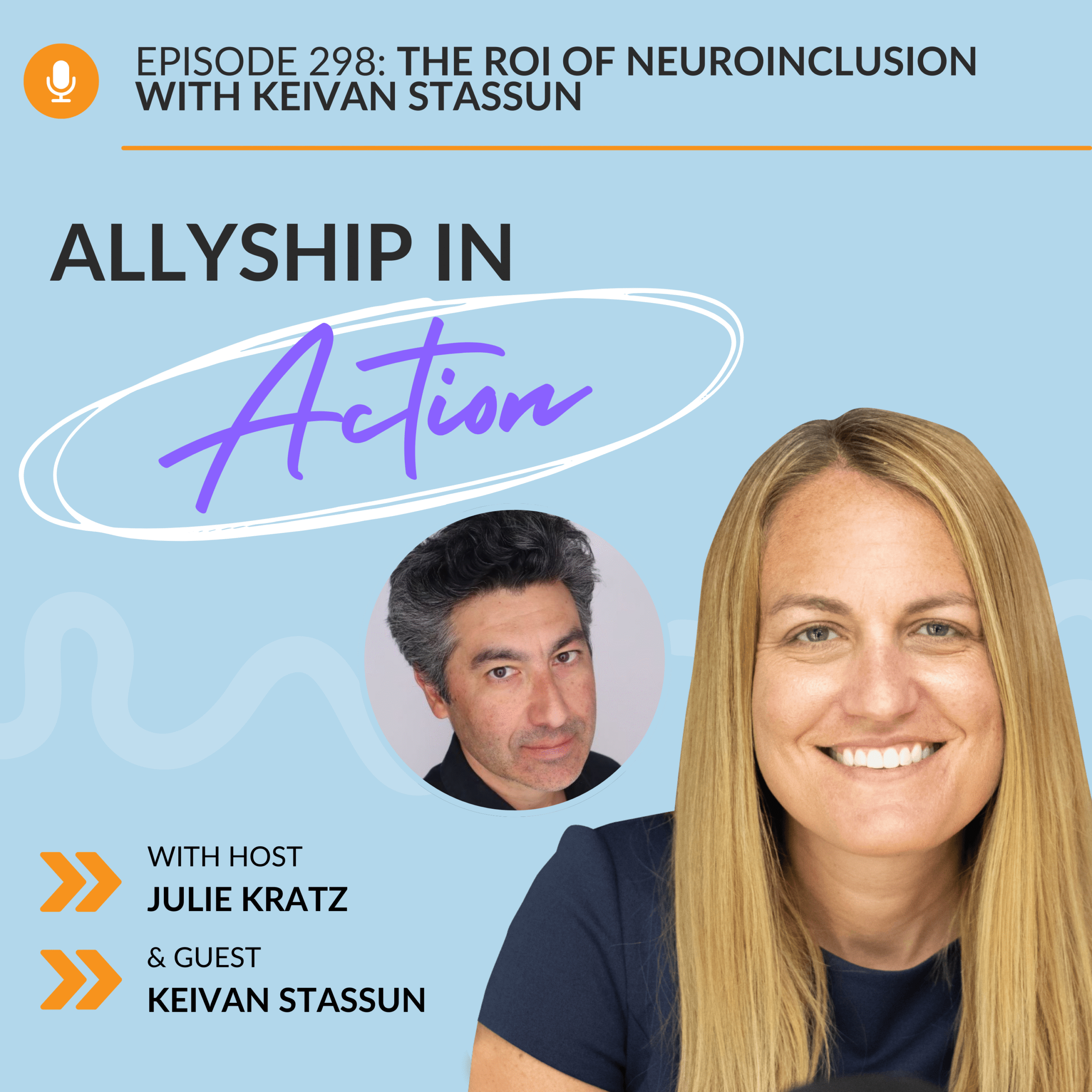
This episode of the Allyship in Action Podcast with Julie Kratz features Keivan Stassun, an astrophysicist and the founding director of the Frist Center for Autism and Innovation at Vanderbilt School of Engineering. Stassun shares his personal story as the father of an autistic son, which inspired him to create a Center focused on leveraging the strengths of neurodiverse individuals in science and engineering. This discussion covers the benefits of neurodiverse teams, the importance of workplace accommodations, and innovative models for employing autistic adults.
Listen Now:


The ROI when you focus on Neuroinclusion
This episode of the Allyship in Action Podcast with Julie Kratz features Keivan Stassun, an astrophysicist and the founding director of the Frist Center for Autism and Innovation at Vanderbilt School of Engineering. Stassun shares his personal story as the father of an autistic son, which inspired him to create a Center focused on leveraging the strengths of neurodiverse individuals in science and engineering. This discussion covers the benefits of neurodiverse teams, the importance of workplace accommodations, and innovative models for employing autistic adults.
Key Takeaways
- Neurodiversity drives innovation and strengthens teams: Keivan’s experience in astrophysics, particularly the groundbreaking discovery made by his neurodiverse team, powerfully illustrates how embracing different cognitive styles leads to novel problem-solving and enhanced outcomes. Clear communication, beneficial for everyone, becomes essential in neurodiverse teams, ultimately making the entire team more effective.
- Support for autistic individuals needs to extend into adulthood: While significant progress has been made in early intervention for autism, there’s a critical need for increased focus and investment in supporting autistic adults in higher education and the workforce. This includes providing appropriate accommodations, fostering inclusive environments, and recognizing the unique strengths and contributions of this community.
- Creating inclusive opportunities benefits both individuals and organizations: Models like The Precisionists Inc. (TPI) demonstrate that tailored support and understanding of neurodivergent needs can lead to high-quality work, increased employee loyalty, and reduced errors. By shifting perspectives and implementing practical accommodations, businesses can tap into a valuable talent pool and achieve tangible benefits.
Key Quotes
- “I’m absolutely convinced that new discoveries and innovations happen because the team invited and included and supported the full diversity of thought.”
- “There has been so much less investment has been autistic people who are over 18 years old where people spend the majority of their lives in adulthood.”
Actionable Allyship Takeaway:
Recognize and actively leverage the unique strengths and talents of neurodiverse individuals while also providing necessary support and accommodations. Keivan emphasizes that focusing on both the support needs and the strengths of autistic individuals is crucial. He provides examples of how companies can benefit from the talents of neurodiverse employees (e.g., employee loyalty, attention to detail) while also highlighting the importance of providing appropriate accommodations to ensure their success.
Find Keivan at https://my.vanderbilt.edu/kstassun/ and find Julie at https://www.nextpivotpoint.com/
Read more about this topic and our interview in Forbes.
Full Episode Transcript Available Here
Speaker 1
Welcome listeners. I’m so excited to have Keivan Stassen today with us. He’s the founding director of the first Center for Autism and Innovation in Vanderbilt School of Engineering, and they focus on advancing science and engineering through the engagement and workforce development of autistic individuals and those with other forms of neurodiversity. And has awarded more PHD’s to autistic students and engineers than any other program. He’s also serving on the National Science Board is a MacArthur Fellow and comes to us with a rich academic background. Kevin, welcome to the.
Speaker 2
Oh. Thank you so much for having me.
Speaker 1
I’m excited to dig. In can you tell us the back story on how you started the Center for Autism and Innovation at Vanderbilt?
Speaker 2
Yeah, happy to. And just to to an important correction on the pronunciation. That’s the first center. First you.
Speaker 1
Oh, it is. First I thought it was a misspelling. Thanks for calling.
Speaker 2
Know it looks like that. Yeah, yeah. Yeah, no, the the first Family Foundation, very generously endowed the center in 2018. And we’ve been going ever since. Back story, I would say, you know, really begins with my personal experience as an astrophysicist who’s also the dad of an autistic son. He’s 18 now, but when he was diagnosed at 40 years old. You know, started the journey that so many families. Go through first just learning about autism and what it meant and you know all the ways that we could best support our sun in those early years. But it wasn’t too long before he was no longer a. Little kid, you know he. Was a middle schooler and getting on to. High school and. And and and and I hear this all the time from families. Now that you know, right around then you really start to as a parent, you start to wonder. Well, you know what? What what’s what’s next? What happens when? This autistic child becomes an autistic adult, which they all do. And what are the opportunities going to be? How is the world going to regard this person who has real support needs but also has has much to contribute? And so. I started intentionally recruiting autistic students at Vanderbilt to join my astrophysics research. And two very important things happened. One is which I expected. The first one is that I learned how to be a better manager of a neurodiverse team. How to help my team effectively communicate with them, and it really just made the team better all around team. Learn how to be more precise in our communication.
Speaker
OK.
Speaker 2
Depending less. Innuendo or? In relying less on imprecise communication, just make the team better. So that’s the first thing that happened. I expected that the second thing that happened, that was by no means assured.
Speaker
OK.
Speaker 2
Is that we as a team we we we made bigger and better scientific discoveries. One of my favorite stories. Which was the subject of an interview by Anderson Cooper and is that of one of my students who developed a completely novel way of of exploring big data sets, which. We deal with.
Speaker
Honey.
Speaker 2
And with the tool that he invented, we ended up. My team ended up making a groundbreaking discovery. I don’t mind saying and you know, giving credit to. Students. That was published in the journal Nature. You may know that stuff. Top scientific journal, the world. It was a a new way of measuring the the sizes and ages of stars just based on how their light flickers. Unexpected discovery. It was a big discovery and I’m convinced I’m absolutely convinced that discoveries like that when. Because the team invited and included and supported. Full diversity of movement.
Speaker 1
That’s such a great story. I’m so glad Anderson Cooper was able to feature it and spread it with folks. That’s something to be really proud of. Yeah, I’ve seen the benefits of neuro diverse teams myself and the mom and also a mom of a kiddo with autism. So I feel your parenting journey. I’m at the very beginning. So I hope the world has more centers like this so that she can participate equitably. Really. And have opportunities? Yeah, by using more clear language, we’re more clear with our communication by providing an open environment for participation, we get better innovation, new ideas. So it all seems like really common sense. But as you know, there’s not as much investment in this. As we would like to think, there is, what are some of the barriers you’re seeing for centers like this or people that want to help the neurodivergent community or autistic community as a whole? Like where are some of the barriers right now?
Speaker 2
Maybe I’ll slip. I understand. What? What you mean by barriers? Maybe I’ll slip that and just say, you know, the way that we look at it is what? Where are the wide open opportunities just because you know the, you know, there are areas where there just there hasn’t been less investment and so. Those are wide open, open opportunities. You know in, you know, in in a word, adulthood, you know, my my son, your daughter. I’m sure you know, benefit in those early years. Tremendously from decades of research and investment in early intervention, you know. You know, I’m grateful that when my son was in elementary school, we could say to the teachers this is an autistic child and the teachers had enough understanding to just even know how to begin the conversation. That was not true. 20 years ago, 30 years ago and and the fact that it’s true now or true or now represents, yeah, decades of investment to research and other investments for support of young children. But where there has been so much less investment is been autistic people who are over 18 years old. And of course, people spend the majority of their lives in adult well, you know how we come to feel. Included integrated use. That our lives have meaning, right? So much of that. Begins to take shape in early adulthood and into. And so. You know that that that’s just where the biggest opportunities are. And so the first Center for us is an innovation our entire mission. Is to develop technologies and to transform workplaces. For artistic forms. Inspired by the diversity and neurodiversity by neurodiversity, I mean a recognition of both the support needs. And the strengths that are there to be determined. And so so, you know, we’re working on. Well-being educators be better informed. Especially in higher education. Where compared to K? Through 12 schools. Professors like me and colleges and universities generally receive no training and it’s.
Speaker
You know.
Speaker 2
Our understanding of how to support statistical college students and that can be such an important time. Meaningful employment, but then also working with companies, working with employers and jobs. Around. New ways of recruiting people, recognizing talent and supporting them.
Speaker 1
Yeah, I like how you explain that. There’s kind of two sides. Of it like we are. The ways to meet the unique needs of the autistic community, but also the unique strengths that they bring. So we’re not forcing kind of neurotypical mess on a community. That we’re we’re getting the full benefits of their diversity rather than kind of, you know, kind of conforming. And so I love that. Keivan, would you mind kind of explaining, like, if, when, this whole idea of, like, there’s a lot of support in the earlier years but not in the later years, right, and adulthood? A huge part of someone. Like so, I wonder like as kids approach adulthood as they enter university like yours as they enter the workforce or look for workforce opportunities, what are the accommodations that we should be thinking about or what are the ways to meet their unique needs? And then also like what what do you see as like the new unique capabilities they’re bringing that make because to me it’s kind of like a math equation like you put the inputs and you get the outputs like you need to do the things to make the conditions right to get the outputs of the benefits of diversity.
Speaker 2
Yeah. So I mean, I think it’s important to just acknowledge just very in a very clear eyed way. That right autism is a spectrum. It is a broad spectrum. And so there’s. A very wide range of of supports. You know we. And and and sometimes the support needs and the and and the strengths kind of go together in surprising and counterintuitive ways, you know, with my own son, as one example, my son, he’s very intelligent and. Will will probably for the rest of his life, require relatively high level of wrap around supports and I’ll say more about that. But you know, so there’s one example of sort of high intelligence and needing relative violence. UM. Another example is one of the one of the PhD students currently that we have at Vanderbilt. When he finishes his PhD in to, he will, to our knowledge, become the world’s first nonverbal autistic PhD neuroscientist. OK. So again, I mean, you know sort of the the, the, the support needs can range and type and degree and the ways that the support needs. Go along with strengths and abilities can be very big. They can, they can go together and but so in thinking about workplace accommodations and. Depending on the individual, you know we’ve seen some low hanging fruit, low cost ways of supporting people that that all employees oftentimes welcome that can that can make a big difference. The ability to use noise cancelling headphones. Having, you know, quiet. Spaces to decompress. And manage and manage stress. Tip sheets for employees you know for all employees to just have sort of little reminders around things like precision and in in workplace communication so that everybody benefits from just clearer communication and clearer. Understanding, but in particular autistic individuals. Aren’t trying to read between the lines when if. If they’re just told very directly and clearly what needs to be done, they can. You know, they can do it, they can do it. So that’s sort of 1. Well, one sort of set of examples of accommodations or sports. That have allowed some, you know, big companies, Microsoft. Other big companies to implement some of these things and to be able to. Buy your large numbers. But but as I said, you know. Some folks just. Require. Different or more or a higher degree of and so for example, my son is starting to work at a company here in Nashville called the precisions corporated TPI. TPI as a really interesting business model. They have locations now in Wilmington, DE, and Philadelphia and Nashville and Phoenix and Cleveland, and then moving into a number of other cities.
Speaker
Yeah.
Speaker 2
TPI hires autistic adults. To to perform business services or contracted work for other companies, they have clients. Big, big corporate clients, we outsourced to TPI. You know, all kinds of back office kinds of work, you know, accounting, legal, document review, all kinds of things. But TPI hires autistic individuals into their offices where they can provide. Now. All of the supports that may be needed on site, job coaches, mental well. Yes. And, you know, projects managers who kind of help break down tasks for individuals who may have higher executive functions. So you know, and I use that example with with my own son who you know is very intelligent and who will perform at a very, very high level. If he’s afforded the opportunity to work in a setting like that one. So you know everything from, as I said, relatively simple, straightforward but highly effective, supports 2 entirely different business models. That, that, that, that perform at a high level and can offer high level service offerings to corporate clients, but do it in a way where you’re leveraging A neurodiverse resource and providing higher levels, yeah. And the kinds of. Benefits. You know that that that companies see whether they’re hiring untrusted individuals to directly or they’re working with companies like C9 to engage them. That population more indirectly is, you know, various metrics that we track are things like employee loyalty. This is a this is a workforce that tends to be highly, highly loyal. So you know less turnover which which represents some big cost savings. A a high quality. High quality of performance and the comes to detail for you to. So less less error being very simple tasks. Which means less redundancy saves on calls. So you know, in, in, in a number of ways. You know, companies are seeing that there’s potential. For higher performance, better order products. You know, have have to engage this workforce in.
Speaker 1
I like the TPI model because it kind of you know, I think about myself as a small business for example, or businesses that are growing that may not have access to the tools that the Microsofts of the world have right like. It shouldn’t be super complicated. It shouldn’t require a ton of investment to make this work, but there’s a lot of nuance to it and having to figure that out for one person versus contracting with somebody who’s already got that figured out that you’re going to pay a premium for but one that you can afford that makes sense for your business.
Speaker 2
Right.
Speaker 1
I just love that. And then they have a community that’s filled with support, probably in that office space too. So it’s I’m not the only one that I can. Do this for.
Speaker 2
And and the quality of the work product makes it so that the the the. You know that that there’s a value proposition there.
Speaker 1
Yeah. Yeah. Like you said, last errors like, more intelligence, new ways of thinking like these are all things that are keeping business leaders up at night. But I think it holds them back as they think I’d have to change all my management policies or I’d have to think about this person all the time to make it successful. And you and I know it’s not that.
Speaker 2
For you to engage.
Speaker 1
Complicated, but in people’s minds, I think sometimes they build it up to be, especially if it’s the first time they think it’s the first time. It probably isn’t.
Speaker 2
Yeah. Well, and also recognizing that, you know, people are also compassionate and, you know, they they they I think are understandably. UM. Concerned, oftentimes, and I hear this from business leaders who say, you know, I I, you know, I hate to bring somebody into the organization and and and fail at supporting them. And now I’ve maybe done hard you know so you know. People want to do, do, do.
Speaker 1
It right? Yeah. They don’t want to mess up, especially if something is important and sensitive as this one’s mental health or well-being and the the teams, you know, feelings around it. You want it to be a positive experience. You want to get it right, but you and I know people are going to mess up, and that’s OK. It’s how you handle and repair those mess up moments as learning. Opportunities too, but not everyone knows what we know. I find that most times when I run into folks that have an autistic person in their family, especially as a caregiver like. Yes, you just know all the things because of our lived experience every day, right? And everyone’s different and there’s a huge spectrum as you said, but I can dial in on it pretty well. Now when I meet somebody, it’s like, oh, I feel like there might be more going on there, you know, and I don’t want to label anybody. I would never say that to their face. But it’s like, you know, I might flex my approach a little bit. And just stick to the facts or you know, not have a lot of ambiguity or adjust to their sensory needs like I’m trying to flex in the moment. So these things. They’re just little nudges or little pivots. It it, I haven’t found. It requires a ton. Of work on my part. But like you said, those little modifications provide an environment where you can leverage these amazing natural strengths too. And to me, it’s worth it. It’s clearly that investment is worth it. Being curious, not judgmental, just being open to new ways of thinking. People processing in different ways. At my right now or my daughter is she’s starting to develop verbal capabilities. So she’s four and a. Half. And it’s just really interesting to think about the world for her, because so many 40% of autistic people are nonverbal. So I’ve been prepared for that, and it’s nice to hear that story about your PhD candidate because it is doable. And so I just love that. But what I’ve seen is what she what she might struggle with verbally. She makes up for nonverbal ways, too. And so it’s just a different way of communicating, but not a way we’re used to. So some of this is a mind shift thing. Some of this is having, you know, academic resources like yourself having the TPI’s the world.
Speaker 2
Mm-hmm.
Speaker 1
You know, standing up for autistic folks and providing some amazing community of resources so. Really proud of the work you’re doing and thankful for it, Caitlin. And are there other things we haven’t talked about today that you wanted to make sure to talk about or any other tips you wanted to leave our listeners with?
Speaker 2
Oh gosh, you know, I mean, I. You can decide whether you want to include this at the end or not, but you know I I would be remiss if I could we just acknowledge that this is a really challenging time for those of us who are working. Any area that might be regarded as related to excessive duty, which this work very much is, I mean, I say that proudly. You know, we are and I think of and I think of the work that we’re doing, as you know, I’m a patriotic American. I think about how we’re tapping into our. Are the best and brightest of of of our very own, you know, to support American competitive economic competitiveness, scientific and technological competitiveness and. You know, recognizing talent in all of these forms, you know, I just, I’m being very frank with you here that for me, that work is among among many other reasons. It is also patriotically motivated and it is a hard pill to swallow. Right now to have that very motivation crash up against the. Yeah, a set of perceptions and attitudes that are literally taking away the funding that we need to. Do this week. And and disparaging and, you know, I know a lot of.
Speaker 1
And totally unacceptable, just unacceptable behavior happening right now. OK, but I totally agree with you the the funding stuff is real for organizations like yours and for a lot of my corporate clients, they’re very afraid to even talk about these things, even neurodiversity, because it has diversity and it has been thrown into the crosshairs.
Speaker 2
Us are dealing with that.
Speaker 1
So done this work for 10 years and I’ve never seen it so fraught, but. I’m thankful for the organizations that are standing to speaking truth to power right now, and I’m hopeful that your organization will continue to have funding by brave people that know this is the right thing to do and we can weather the storm we have to one in 36 births. Like, are you kidding me? Like what are we going to do? Right. We’re going to need folks. We’re going to have to integrate as a society.
Speaker 2
Yeah, yeah.
Speaker 1
This is a solvable problem too, as you’re to do as your community has done so. Thankful for your work. I appreciate your tenacity and clearly your passion for this subject and as somebody that hopes to be the beneficiary of all the great good that you’re doing now, I know my daughter will definitely. Have more opportunities in the future because of work like those that are doing it like you right now.
Speaker 2
Thank you.
Speaker 1
Thank you, Keivan. Thanks for being on the show.
Speaker 2
OK, take care
