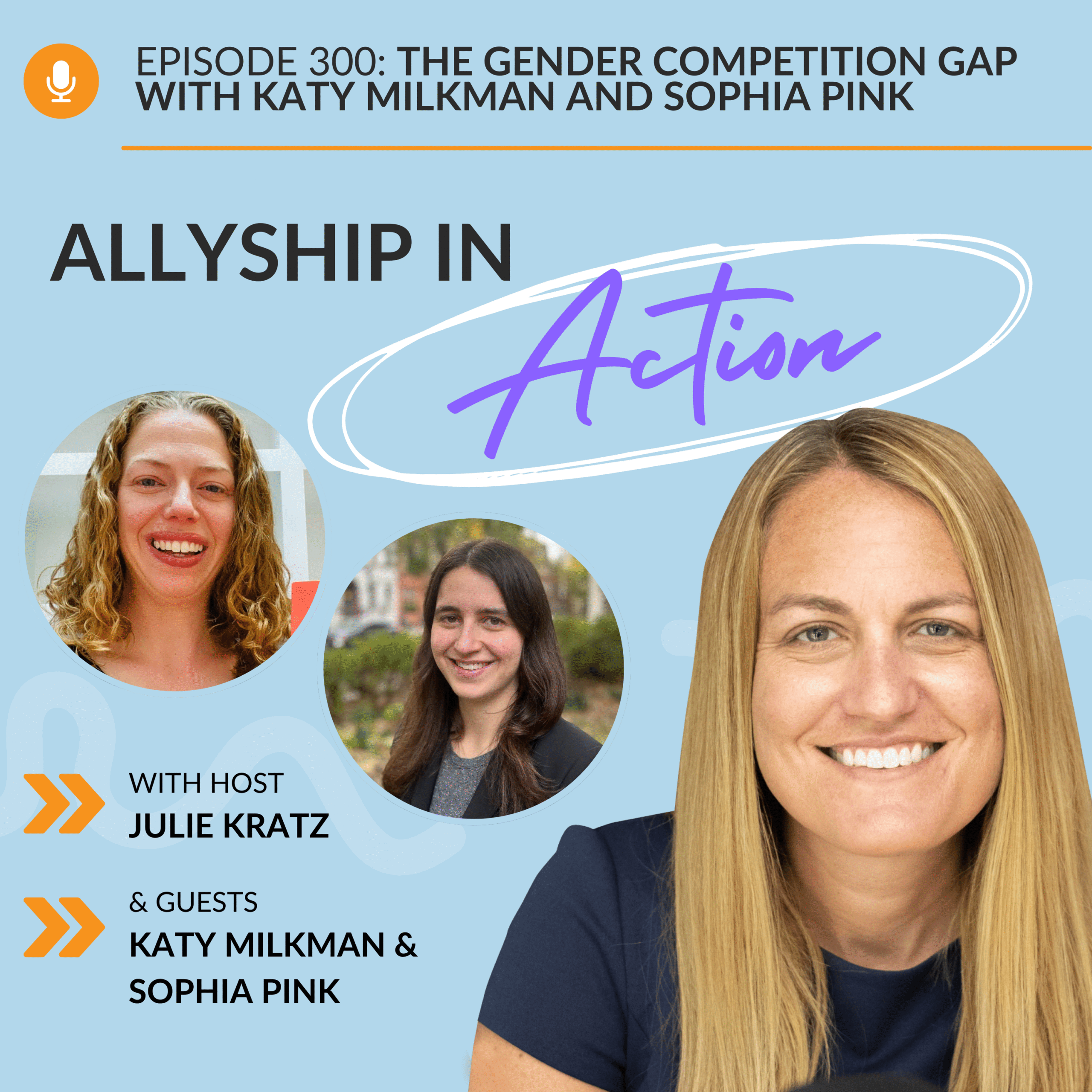
With special guests Katy Milkman and Sophia Pink
Katy Milkman is the James G. Dinan Professor at the Wharton School, the host of Charles Schwab’s Choiceology podcast, and co-directs the Behavior Change for Good Initiative. Sophia Pink is a PhD student at the Wharton School studying decision-making and behavior change. They join Julie Kratz on the Allyship in Action podcast to discuss their new research on the gender gap in competition. They highlight that women are, on average, less likely to enter competitions (like applying for jobs or promotions) than equally qualified men, a phenomenon observed across many decades and countries, even at the top of the labor market.
Listen Now:


The Gender Competition Gap
Katy Milkman is the James G. Dinan Professor at the Wharton School, the host of Charles Schwab’s Choiceology podcast, and co-directs the Behavior Change for Good Initiative. Sophia Pink is a PhD student at the Wharton School studying decision-making and behavior change. They join Julie Kratz on the Allyship in Action podcast to discuss their new research on the gender gap in competition. They highlight that women are, on average, less likely to enter competitions (like applying for jobs or promotions) than equally qualified men, a phenomenon observed across many decades and countries, even at the top of the labor market.
Their research explored interventions to address this gap. Counter to traditional psychological theories like stereotype threat, they found that explicitly telling women about this gender competition gap – with a message like “don’t let men get all the advantage” – actually increased job applications from women by about 20%. This phenomenon, which they call “stereotype reactance,” suggests that highlighting the disparity can motivate women to defy the stereotype.
Katy and Sophia also discuss other systemic interventions, such as defaulting individuals into competitions (e.g., automatically submitting them for promotion unless they opt out). They suggest that this gender gap is likely cultural rather than biological, possibly stemming from social norms and differences in confidence levels. They conclude that while broad cultural shifts are challenging, targeted, “just-in-time” interventions and structural changes within organizations can significantly help close these gaps and ensure organizations access the best talent.
Key takeaways from this conversation:
- The Persistent Gender Gap in Competitive Environments and Its Consequences: The discussion begins by establishing the well-documented phenomenon that women, on average, are less likely to enter competitions (like applying for jobs or promotions) than equally qualified men. The speakers emphasize that while this reluctance is not inherently negative in all contexts, it can significantly disadvantage women in crucial career advancement opportunities, particularly for leadership roles that often require navigating multiple competitive stages. This theme highlights the problem and its potential impact on gender equity in the workplace.
- Leveraging Psychological Insights for Intervention: The Power of Stereotype Reactance: The central focus of the new research is the innovative application of “stereotype reactance” as a potential solution. The researchers hypothesized and found that informing women about the existing gender gap in competition could paradoxically increase their likelihood of applying for jobs. This is attributed to women’s potential desire to resist conforming to negative stereotypes and a motivation to take action against the observed inequality. This theme underscores the use of behavioral science principles to design effective interventions for addressing the gender gap.
- Systemic and Just-in-Time Approaches for Organizational Change: The conversation moves beyond individual behavior change to discuss broader organizational strategies. Recommendations include implementing “default” mechanisms where individuals are automatically considered for opportunities unless they opt out, and providing timely reminders or prompts at the point of decision-making. The speakers emphasize that while long-term cultural shifts are challenging, these more immediate, systemic adjustments and “just-in-time” interventions can create a more equitable playing field by mitigating the impact of confidence barriers and internalized norms. This theme focuses on practical, actionable steps organizations can take to address the competition gap and promote gender equity.
Actionable Allyship Takeaway:
When you see a woman hesitating to pursue an opportunity for which she is qualified, gently remind her of the gender competition gap by saying something like, “Hey, men tend to apply for this, don’t let gender stereotypes hold you back,” to encourage her to take the chance.
Check out Katy and Sophia’s research at: https://pubsonline.informs.org/doi/10.1287/orsc.2024.19563
Read more about this topic and our interview in Forbes.
Full Episode Transcript Available Here
Speaker 2
So so excited to kick off another incredible episode and I have two amazing guests this week, Katie Milkman is the James G Denon professor at the Wharton School and the host of Charles Schwabs Chase Choice Elogy Podcast and Co directs the Behavior. Change for good initiative and so if you have pink is also with us a PhD student at the Wharton School. She studies decision making and behavior change. Welcome, Katie and Sophia.
Speaker 1
Thank you. Thanks for having us.
Speaker 2
OK, so let’s dig in y’all have some new research you’ve been working on. I can’t wait to. Learn about it and. Hear what’s you’ve. Learned and and more importantly, what we need to take action on. So fill us in. What’s the new research about and what are some of the key findings?
Speaker 1
Yeah. So there’s lots of work showing work over many decades in many countries showing that on average, women are less likely to choose to enter competitions than men. And this isn’t inherently a bad thing, right? It might be the right decision to not enter a competition, but in some contexts, particularly contexts like choosing whether or not to apply for a job, choosing whether or not to put yourself up for promotion, these are really consequential decisions. And if women opt out of competitions, this can put them at a disadvantage, especially in context. Like for leadership roles, where in order to access a leadership role to become a CEO or any kind of. Enter any kind of top position. You usually have to have chosen to enter many competitions to get there. So we were wondering, OK, what can we do to to make a difference in this situation? And so we were wondering, well, what if we just told women when they’re making the decision of what jobs to apply for? What if we just told women? That women on average are less likely to apply for competitions like applying for jobs than equally qualified men, like what would that do now? Classic psychology research might suggest that that would be a terrible idea, because if you tell women people like you don’t compete, we know people conform to social norms, so that might make women refrain from competing. Or there’s also research on something called stereotype threat, which shows that in some context, if you’re a mind people. Like women of a marginalized identity, it can make them feel anxious or worry about their identity or worry that they’re gonna do badly. So a lot of work would say you should never, you know, would would suggest you should never tell women that they’re not gonna they’re they’re have a propensity to not compete right before they’re making this decision. But we thought maybe that’s missing out on something. Maybe that doesn’t tell the full story. We are and and we actually thought that telling women this information could encourage them to apply for even more jobs. And the reason for this is because of something called stereotype. Reactants. Now, reactants is something in psychology. It’s a phenomenon in psychology where when someone tells you, yeah, don’t do this, it makes you kind of want to do it. So, for example, if you see a big red button and there’s someone who says, you know, or a big sign that says don’t press the red button. Suddenly you kind of want to press the red button, so that’s reactants. So we thought maybe telling women. You know, women tend not to compete as much as men, even if they’re equally qualified, can make women think, hey, like, I don’t want to be making decisions about what I do just cause of my gender and could make them apply to more jobs. So that was the idea. And what we did is we ran a field experiment on a job application site for executive and board roles. So this is a site where to access a site you had to be essentially at the top of the labor market. So you had to be eligible to get an executive role to get a board role, BP level role. What are these? Top level job. And was interesting is on this site we saw that even among people who were already at the top, we still saw this gender gap in job applications. So equally qualified women were still less likely to apply to jobs than men, even at this. Like, really, really top of the top of the labor market. Group. So what we did is we ran an experiment where we women on the site we randomised 1/2 of them to see a message. That said what I told you before that said hey, did you know that women are less likely to apply for jobs than equally qualified men? You know, don’t let men get all the advantage. Apply for any jobs. Kind interest. The other half of women were just told applying for job is good. It has benefits apply for jobs you find interesting, and then we looked at how many jobs did women apply to on the day they saw this message and what we found is that women who saw this reactance inducing message where they learned about this gender competition gap applied to about 20%. More jobs on the day they saw the banner, so it led to this big and meaningful boost in job applications from 1. So overall we think that this idea of reactance, particularly stereotype reactants, is a positive tool for closing the gender gap and for a behavior change. In general.
Speaker 2
That’s so cool. That’s so cool. And umm Katie, I know you’ve been doing this work for a long time. What were your reactions to that research finding?
Speaker 3
Thank you for asking. I also wanted to say it was wonderful to work with Sophie on this project. She was an amazing leader on on this work. I think this is really exciting and I was really excited to see the result because we know increasingly what we can do if we have a situation where an organization is willing to change the way, say that it hires. Or change the way that it promotes. To help make sure that underrepresented groups and women aren’t held. Back. But you don’t always necessarily find yourself in a situation where that’s a priority for an organization and creating insights that could potentially be leveraged by third parties. Like a search website or creating insights that maybe even could be leveraged by. Way nonprofits who work in regular communication with, say, women and underrepresented minorities, just to. Help. Give them the right message so that they might be motivated to take actions I think is really exciting. This is really different than saying something like, oh, maybe your promotion structure should be changed. It gives us another lever. That we can push and a lever that more people can push that might help accelerate the closure of some of the gaps that exist due to confidence barriers. Not due to competence barriers, right, these women historically in research studies who are less likely to compete, are just as qualified as men, but due to lack of confidence or anxiety about risk taking, maybe won’t choose to apply even when they could be outstanding. And that’s really hurting. Everyone. So I’m really excited about this work. I think it’s fantastic to have more science based insights we can use and that. For different types of organizations can use in order to help accelerate progress and equity.
Speaker 2
Yeah, yeah. Because why wouldn’t you want the best people applying for your jobs? And if there are systemic interventions we can make like the reminder messages, for example, that’s one thing, but it’s also, I think what you’re getting at is kind of a both and sometimes in the I work, we talked about individuals actions and we talk about systemic actions. So this is kind of a both end, it’s a systemic change, but it’s also. So it operates at an individual level for an individual that’s choosing to apply for the jobs to change that their behavior, and hopefully those reminders can improve the pool of talent for everyone. And I’m curious what, when you think about this research and what organizations could do differently based on this research. What would be your recommendations to organizations that want to ensure this competent competition gap? Rather, isn’t, you know, prohibiting them from finding the best.
Speaker 1
Yeah. So I mean one direct implication from our research would be for organizations to identify the points where there’s a choice of whether or not to enter our competition, for example, identify the point where you’re inviting people to apply for promotion or not or, you know, apply for a new job or not, or nominate themselves for an award. Situations like that and and give people this prompt. At that moment, they’re making a decision because we have evidence that just reminding women of this gender competition up right at the moment where they’re about to make that choice can induce reactants and therefore help. Close the gap. So that’s the main implication. There’s other really cool research that shows other things orientations can do. I think Joyce he and Sonia Kang have some other research that shows that defaulting people into entering competitions and defaulting people into promotion, making kind of people are automatically applied for promotion. Are are submitted to, you know, be eligible for motion and they have to opt out. Can also reduce reduce the gender gap.
Speaker 2
Yeah, I love that default position. Can you tell us more about that?
Speaker 1
Yeah, so this is research. I think they were at the University of Toronto when they ran.
Speaker 3
Yes. And there are. I think there’s additional co-authors as well. Yeah, I know.
Speaker 1
I know, yeah.
Speaker 3
Atera, whose name last name I may be butchering.
Speaker 1
We can add to the link I. Want to make sure everyone.
Speaker 2
We’ll be sure to get credit. Where credit is due, I know I always am in remarkable awe of people that can remember all of the researchers. To a given study. So but I I.
Speaker 3
Yeah. Yeah. So I think it’s OK to just.
Speaker 1
Name her at the moment. But, but yeah, they found they were addressing like a similar issue, right? Women are less like to enter competitions like applying for jobs like applying for promotions. We were taking the. Our work was more like Katie was saying, let’s say you’re not in an organization. You’re kind of a third party.
Speaker 3
Yeah.
Speaker 1
After like a job website and you can’t change organizational policies. What can you do? So we provide our work provides a. Reactants inducing message. But if you’re inside an organization and you could actually make policy changes, make structural changes. What they found is that if you basically make the choice of whether to enter a competition or not, kind of less influential by just automatically kind of entering everybody into a competition, then. That also close to the gender gap because there’s less of a. Women don’t want to have to clear, like, make the choice like do I want to apply for this? Do I not? The default is, well, just everybody’s submitted for this promotion, you know. And that that closes the gap.
Speaker 2
Too, yeah.
Speaker 3
I’m getting a tickle my. It’s like, well, Sophia, so take my time. Like, I hope you can edit this.
Speaker 2
Sorry.
Speaker 3
And then Professor Murphy had a coughing bed.
Speaker 2
Yeah, it’s alright. It’s candid conversations are always, you know I appreciate the authenticity. And you know, just thinking about this default position to put folks into, you know, I’m thinking about my own corporate experience and the women that I coach that like, you know, there’s this hesitance where we know that men, based on your research just are, are less likely to experience that hesitance, but. I remember. Are just feeling like the boldness of my male colleagues, especially early on in my career like, oh, why we should be promoted after a year. And it’s like what’s like? I would never like think that was the default, right. And so taking away kind of that extra barrier and making it the default I think is really interesting. Do you all have whether you have research or just thoughts on where does this problem stem from? Is it yeah from early on the messages girls get about competition or? Where does it? Where did? Where does it start?
Speaker 1
Yeah, that’s a great question. I think the the real answer is we don’t really know exactly. There is some evidence that it’s cultural. It’s not like a biological phenomenon. There’s some work. Again, I can give you the citations afterwards that suggests that it arises like not among, like, really little kids, but more. When people are older and kind of like learning more cultural norms, there’s also a little bit of work that shows in more kind of matriarchal societies. We don’t see this gap as much, so I think. I don’t we don’t know exactly where it comes from, but we think that it’s something cultural, something about social norms, cultural norms, that about kind of expected behavior for women and expected behavior for.
Speaker 3
Men and and it also is related to confidence. Yeah. So if women, if if women are have their confidence boosted, yeah, that can reduce this gap so. We have differences and there are this has been known for a long time that there are gender differences in the degree to which people are confident about their abilities, even for a fixed ability level. So. If Sophia and a male graduate student down the hall both performed the same way on a test, they would come out of that test with different levels of confidence about their competence, and so that that is a big part of what drives these differences is different perceptions of the same information. But yeah, there’s also. Women are punished for not conforming to societal stereotypes, meaning we like them less if they take different actions. If a woman maybe puts her name in the hat, she may be treated differently when she’s a first year. That may be seen as less socially acceptable than if a man does the same thing with exactly the same confidence. So there’s a whole host of things. Women also are a little bit less likely to take risks in general, less risk loving than men, in part due to overconfidence, but. There’s a lot of wonderful research that’s started teasing these things apart, and I wanted to mention that Muriel Needer Lee at Stanford and Lees Vesterlund, who is a professor at University of Pittsburgh, are the two people who originally identified this gap in competition and women’s willingness to compete and have decomposed some of the elements, along with lots of other excellent researchers.
Speaker 2
Yeah, reminds me rushman saying. Johnny, I know has a book. Brave. Not perfect. And how we socialize gender for girls to be perfect rather than brave and take risks. And so of course, this leads to different behaviors when they enter the workplace, that when it’s more male dominated and that male gender expression. Has been normed more for competition and for taking risk? You know, women can feel that kind of that socialization that’s gotten them. There isn’t going to get them to the next spot. And in this, in, in the corporate world. And so just curious on where that comes from. I know I have an 11 year old and just seeing her hesitant sometimes, especially when I’m. With her at school around. Other children I can see her hesitating or questioning herself. We’re typically not. Not all genders are all the same, right? But you don’t see that same hesitance of her male counterparts at school. So it’s just interesting these messages we get as kids kind of manifest and then. Can’t be so helpful in the workplace, so I’m curious.
Speaker 3
Now I also have to interrupt and say as a parent of a of a male, sometimes it’s also that the girls mature faster to thinking about social norms. Than the boys.
Speaker
Yeah.
Speaker 3
Hey, but but then? Again, by the time they’re full. Grown the social messages they’ve gotten are certainly contributing, but but my perception isn’t that like 9 to.
Speaker 1
11 you know.
Speaker 3
Yeah, they’re. Well, the men, the boys are uninhibited and the women have started thinking the future to start thinking about. It’s especially the boys just haven’t thought of that at all yet.
Speaker 2
Maybe don’t know this. Yeah, maybe. Yes, a really good point.
Speaker 3
That’s my non clinical assessment with yeah, based on life experience rather than data.
Speaker 2
Yeah. Yeah. Well, it’s a little bit of both as you now lived experience and. Good researchers. Yeah. And so I’m thinking about organizations that. You want. I think a lot of companies when we share research like this are talking like, oh, that doesn’t happen here, right? Like, we don’t have that problem here. It’s happening somewhere else. What would you tell an organization that thinks that this isn’t happening? What might be like a reason for them to care or to try some of these interventions?
Speaker 1
Yeah, so evident. So there’s lots of evidence that this is a really robust finding that we see all over like there’s, you know, hundreds of studies that show that on average, women are less likely to enter competitions than men. It doesn’t mean every single woman is less likely to compete than every single man like, but it just, you know, on average. And I would say that even if you don’t inherently care about, like gender equality or anything, if you’re an organization, you want the best talent. And if some people who are highly qualified or are choosing to not apply, you never see their resume. You never see anything about them. You’re missing. Talent. So I think if organizations want want the best talent then this is good for them.
Speaker 3
That made me feel better about my coughing.
Speaker 2
I’ll be editing this video now.
Speaker 3
Just a little bit. No, I thought that was very endearing too.
Speaker 2
Speaking of gender dorms, so it hasn’t brought me lunch, which is really lovely and nice, but I didn’t know that was going to happen, so my apologies.
Speaker
It’s. No, don’t apologize.
Speaker 2
I will make sure to edit at this point and the cough earlier but.
Speaker
Yes.
Speaker 2
In all seriousness, kind of getting back to this research, I’m wondering you mentioned a couple like key intervention steps, the reminder process reminding people about the competition gap before they enter a competition. The default mode kind of entering people into the promotion pool rather than having themselves select. Well, maybe some other ways to kind of systemically or practice interventions that could mitigate this risk.
Speaker 1
What other? Yeah, favorite. One is the default one.
Speaker 2
Yeah, yeah. I mean, I don’t see that happen very often.
Speaker 3
Yeah, no defaults are great. You know, I think giving more feedback so that people are more aware of their competencies and giving more encouragement can be another way. If you’re thinking about what are the mechanisms and how can I combat these mechanisms, then if we know confidence is a barrier, we might want to boost the confidence. More aggressively and recognize that could be a risk for women. Then and give them added encouragement that they should make sure they put their name in the hat, so defaults are great because they’re a form of encouragement. Essentially, they’re sort of like this is happening unless you don’t.
Speaker 2
Right.
Speaker 3
Per minute to so that makes it hard for people to omit themselves from the competition. They think, oh, OK, this is the norm. Everyone is competing, so I don’t have to make an active choice to opt in. But there are other ways you can make it feel like the norm. To compete, everybody’s doing it. Tell people that you know, like 90, we expect 90% of people to enter The Who who have this many years of experience to enter their name in the hat for a promotion. At this stage in their career, so that it really doesn’t feel like I am doing something counter normative or counter stereotypical by. Applying so I would just think about you know what’s driving it? If it’s a lack of confidence, if it’s, if it’s a perception that this isn’t the normal thing for a woman at my stage to do, how can we?
Speaker 1
Disconfirm those beliefs. Yeah. Yeah. There’s another. Yeah. Related to what? Kitty was saying. Some other work that shows that this is particularly a problem when things like qualifications are really vague because when the qualification for a job is like leadership experience, like, there’s so many ways to interpret it. And so someone who’s less confident. Could say like, well, I don’t have leadership experience and there is more confidence, confidence that could say like I do and this really like this is the. This can exacerbate the gender gap, so there’s some work that shows if you make job requirements or promotion requirements more concrete, there’s less of this room for differences and confidence to to wiggle in, so making things more concrete can also. Yeah, also help reduce.
Speaker 2
The gap. It reminds me too, of the work on gender bias like we know. If we make objective criteria, for example on qualifications and on how people are evaluated for promotion and hiring decisions that we level the playing field. More often too, and kind of mitigate that bias by just having very clear objective criteria and qualifications. Usually. Yeah, I think about that as like a laundry list of like a wish list that we’d want in the candidate versus what we’re actually going to hire for. And so it leaves all sorts of room for subjectivity and bias and just, you know. Unfairly filtering out really qualified.
Speaker
That’s.
Speaker 2
It also reminds me a little bit of one of your colleagues that, you know, I followed a lot of our listeners, follow Adam Grant that does work on scaffolding. So like with hidden potential in his book, like the scaffolding that you provide around people that support. So understanding if there is a confidence issue like. How can I boost it? How can I kind of provide that support so that people feel supported and encouraged to do their best work and to take chances?
Speaker 1
Yeah, definitely. Yeah, I think that’s.
Speaker 2
Is there and having done this research for quite some time, Katie, I’m curious if this is going to lead to other research projects, or if it reminds like where the evolution of this is happening. Cause like you said this competition thing this gap isn’t this. No surprise, but it’s how does it inform how we ultimately. To resolve this problem, because I feel like we’ve been talking about this issue for as long as I’ve been doing the work 20 years in my corporate career, what do you think it’ll take for things to ultimately shift?
Speaker 3
Oh gosh, that’s a great question, you know.
Speaker 2
You had a magic wand.
Speaker 3
Yeah, I. I don’t. I am certainly not optimistic that we can just magically change our culture in a way that girls and boys will grow up with the same expectations, face the same consequences for the same actions throughout their lives on a reasonable time scale. And assuming that I’m correct and that we’re not going to shift our culture dramatically in our lifetimes, or we may shifted dramatically, but maybe not so dramatically, to eliminate any differences in the way we socialize people from different genders, then I think the answer is that we have to raise awareness about these issues and actually. Develop science based tools that help combat them. There’s a lot of research suggesting sort of just in time interventions are particularly useful rather. And you mentioned Adam Grant, he and I were co-authors on a project led by Edward Chang of Harvard Business School, where we looked at what was the benefit of something a lot of organizations do, which is diversity training. We found that diversity training had pretty limited benefits. It along the lines of what we were. We hope that it would have it maybe changes attitudes a little bit, behaviors very little. The main behavior changes we saw were it seemed to scare women and minorities into seeking out more mentorship as opposed to leading leaders of organizations to be more inclusive. So. That was demotivating in the sense that it suggests the solution is not just these sort of long term. Efforts to educate, but rather we need to build in systems to organizations to make them more equitable that don’t require people to think differently, like defaulting people into applying for promotions automatically. The other thing though is that Edward had done some follow up work showing that if you. Insert a short reminder about the importance of diversity into people’s lives right before they hire. Then that actually does make a difference in hiring decisions, so it’s very just in time, and I think this project, which Sophia led, which actually Edward, is a co-author on too. So there’s a a theme in bringing Edward up in these conversations. So this project also is very just in time. It’s right at the moment when someones deciding about whether or not to apply you flash this message up in front of them and it changes the way they think about that day’s decision. It doesn’t seem to change them permanently. So if we look downstream, it’s not like weeks later. They’ve. Revolutionized their behavior, but it’s in the moment when someone’s making a choice. How can we nudge them? How can we restructure choices in order to help facilitate? Closure of these kinds of gaps. So that’s the way I’m thinking about it. Like I don’t think we can change the culture instantly. That seems really hard. Let’s talk to sociologists and and cultural psychologists, not us about how to do that. And that’s a really long term goal. And in the meantime, the more science we can do to figure out what are these just in time solutions or adjustments to organizational processes. That do seem to make a big difference. Then we can employ as many of those remedies as possible to create as much of an equal playing field as possible.
Speaker 2
I love that. I love that so much. Yeah, it’s the the systemic pieces. The just in time pieces that really resonate. And I I think too, I mean I I think about my career at times when I’ve. Question myself or not, put myself in a competition and it often took like one hour ally or one mentor kind of putting up the mirror and being like Julie, you know, I’ve seen you do AB and C like, why not ex. And just and it was usually a male leader, but it often was just that person, just gently reminding me in the moment when I was questioning myself to take a chance. And it’s a big deal. So I think for listeners, you know, being that ally for somebody else, seeing somebody that you seeing something and somebody that maybe they don’t see yet in themselves. And identifying that and proactively recognizing that. Especially if it is critical to a decision that they might be making about taking a risk or entering a competition.
Speaker 3
And I think what Sophia’s work shows is that it’s not just to remind them, hey, this is a good moment. You know, Julie, on your mentor, but also, hey, Julie, not only is this a good moment. But also Joe down the hall, he’s gonna do it. Don’t let. Gender stereotypes hold you back, so we’re giving some extra ammunition to that excellent ally to use to frame that conversation so they can be maximally influential. Not only might you want to nudge Julie. Hey, here’s a just timely reminder, but you may want to frame it around. How, if she doesn’t, she is? Yeah, she.
Speaker 2
Somebody else is going to get it, yeah.
Speaker 3
Yeah. And and. Men tend to apply for this. Don’t let her gender hold her back.
Speaker 2
Yeah. Yeah, why not? You. Yeah. And I think sometimes what I coaching phrase I use a lot with people that are hesitating on opportunities that they’re clearly ready for. It’s like, what’s the worst could happen? Like you don’t get the call, you don’t get the interview like that doesn’t sound like a bad thing that’s going to happen. It’s not like you’re gonna get in trouble. We’re applying to too many J. Jobs it it’s often we kind of build it up in our head more so because of these biases because of these stereotypes. Also research Katie Sophia. I’m so thankful for your work. Tell our listeners. We’ll be sure to to link to the full research study in our show notes in our Forbes piece, but I’d love to know like how can they continue to follow your work or or what are some additional resources you might recommend?
Speaker 1
Yeah, we try to post new papers on social media, on LinkedIn, on our our websites. Kitty also has a podcast where she shares new research. We, yeah, try to get it out there. What other resources?
Speaker 3
Yes. Probably our websites are great. Is yours Sophia pink.com correct. Katiemilkman.com and I have a newsletter called Milkman delivers which is another way to find me choice elogy the podcast and I wrote a book but it’s not really on this topic but it might. Be of interest? Simulated. It’s sold out and. Change and and it’s mostly focused on achieving goals, but some of it can. Be applied to these top.
Speaker 2
And and what is the name of? The book Katie.
Speaker 3
It’s called how to change the science of getting from where you are. And where you want to be.
Speaker 2
I love that. I love that. Oh, good. Well, good self promotion in action right here with all of these. Amazing.
Speaker 3
That’s right. And women self promote less than that. So we’re we’re doing it. Thanks for nudging us in a timely manner to self promote.
Speaker
Well, and you’re.
Speaker 2
Not alone. I mean, academic researchers rarely self promote these things, so just by way of being on the podcast and sharing this amazing knowledge and and resources, I’m just super thankful for your work and. Keep showing up now more than ever. We need your voices. So thank you for this important work.
Speaker 3
Thank you so much.
Speaker 1
For having us, thanks for having us.
