
If I’ve heard it once, I’ve heard it a thousand times: “I’m afraid to give feedback,” or “I just don’t want to hurt anyone’s feelings.” We tie ourselves in knots, especially when giving feedback across differences. We fear the conversation will deviate into drama, accusations of bias, or simply awkwardness. As a result, we often withhold the very thing that helps people grow—and frankly, withholding feedback, especially from those who are underrepresented, is a form of exclusion. It holds back talent and prevents people from realizing their true potential. We can’t afford that in today’s increasingly diverse and competitive world.
So, how do we pivot from fear to constructive action? By leading like an ally, and that means adopting tools that make conversations about performance and behavior intentional, specific, and focused on growth.
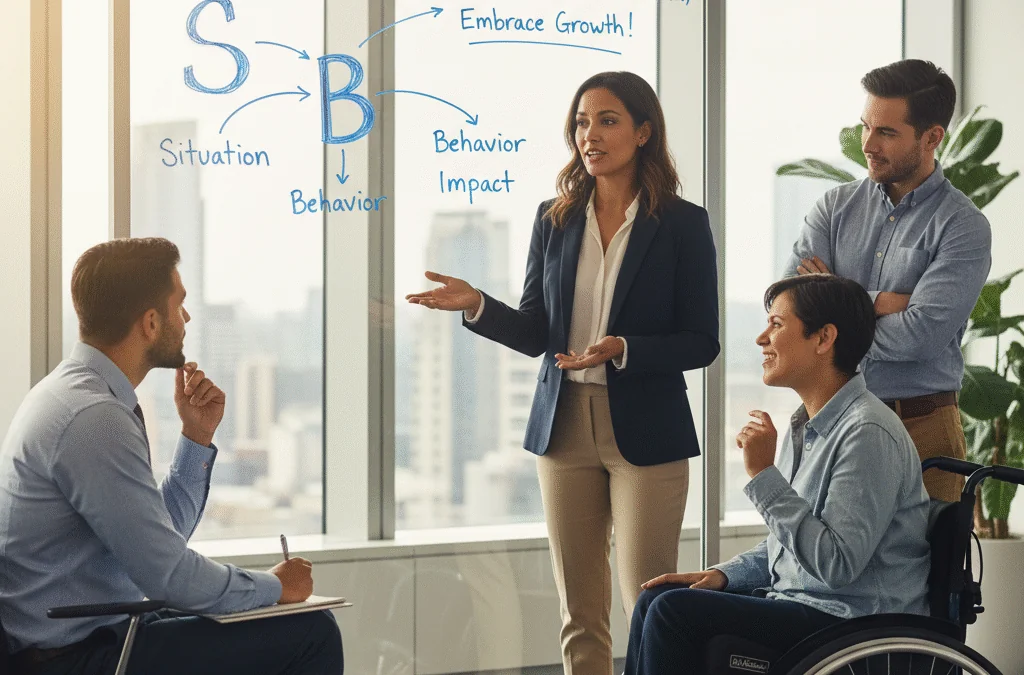
Enter the SBI Model: Situation, Behavior, Impact. It’s a simple, evidence-based structure that strips the emotion and judgment out of feedback and anchors it in observable facts. When done right, it’s not just a management tool—it’s an allyship tool that fosters psychological safety and creates a culture where everyone feels seen, heard, and knows they belong.
S is for Situation: Set the Stage
The most common mistake in giving feedback is starting with a vague generalization or—worse—a judgment about a person’s character. “You’re always late to meetings,” or “You have a bad attitude.” Ouch. Those statements put people on the defensive immediately, and the conversation is over before it begins.
The Situation step is all about getting granular. Where and when did the event happen? State the context clearly, objectively, and without interpretation.
- Instead of: “You were unprofessional in the team meeting.”
- Try: “During yesterday’s 10 a.m. virtual project sync-up call…”
This takes the conversation out of the abstract and into a specific, shared reality. It signals to the other person, “I want to talk about this one moment,” not “I think you are a problem.”
B is for Behavior: Stick to the Facts
This is the most crucial, and often the trickiest, part. Behavior must be observable. You need to describe exactly what the person did or said, as if you were recording it on video. You are a journalist reporting a fact, not a judge delivering a verdict. This is where we park our emotions and biases and focus purely on action.
- Instead of: “You dominated the conversation and interrupted people.”
- Try: “…I noticed that you cut off Sarah when she was explaining her Q3 results, and you spoke for four minutes without a pause.”
Notice the difference? The first is a label. The second is a specific action. By focusing on the behavior, you remove the personal attack and keep the focus on what can be changed. We are talking about the doing, not the being. This is especially important for women and people of color who often receive “personality feedback” (e.g., “be more confident,” “you’re too aggressive”) instead of actionable behavioral feedback.
I is for Impact: Why It Matters
The final piece, Impact, explains the consequences of the behavior. This is where you connect the dots back to the team, the business goals, or the culture. This is the “why” that makes the feedback meaningful and actionable.
- Instead of: “It was really rude.” (A judgment)
- Try: “…The impact of this was that Sarah looked visibly frustrated and didn’t get to finish presenting the final data point, which means we left the meeting without a full picture of the quarter’s performance.” or “…The impact is that others may hesitate to share ideas in the future, which prevents us from having an inclusive environment where all voices are heard.”
The impact explains the stakes. It clarifies that this isn’t just about your personal preference; it’s about the collective success and inclusion of the team. As an ally, this is your opportunity to highlight how a specific behavior undermines the inclusive culture you are working to build.
The Allyship Pivot
The SBI Model works because it’s non-judgmental and focused on growth. It gives the recipient a clear roadmap for what to start, stop, or continue doing.
Remember, allyship is action, not just intention. Using the SBI Model is a tangible way to put allyship into practice:
- It’s Equitable: By focusing on behavior over personality, you ensure everyone receives fair, clear, and actionable feedback.
- It’s Courageous: It requires the courage to speak up in the moment (or shortly after) instead of avoiding the discomfort and letting resentment fester.
- It Builds Trust: Clear, fact-based communication is the bedrock of psychological safety. When people trust that your feedback comes from a place of care and growth, they are more likely to hear it and act on it.
Ready to pivot your feedback style? Start small. Use SBI this week to share a piece of positive feedback—you’ll be amazed at how clearly it lands. Then, when a difficult conversation is needed, you’ll have the muscle memory, the structure, and the ally mindset to lead with clarity and care. Your team deserves it. The work depends on it.
Now, go lead like an ally.