
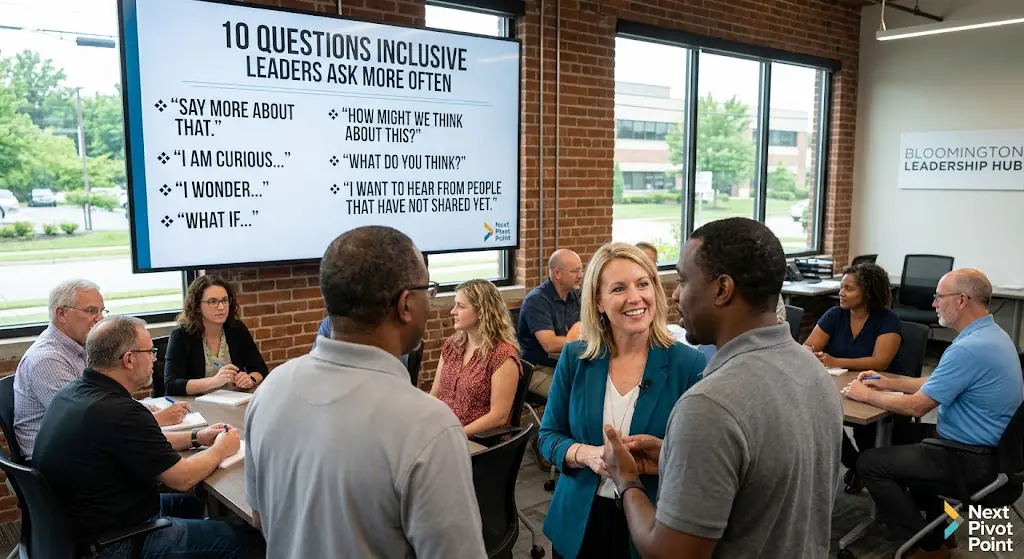
In my work training thousands of leaders across Corporate America, I hear the same worry again and again: “Julie, I want to be a more inclusive leader, but I’m terrified of saying the wrong thing.”
I get it. Fear of making mistakes is real. But here is the truth about authentic allyship: Inclusive leadership isn’t about having all the right answers. It’s about asking better questions.
When we pivot from a mindset of commanding to one of curiosity, we create psychological safety. We step back from power hoarding and step into power sharing. The fastest way to transform your workplace culture and boost talent retention is by shifting the dynamic in your daily conversations—starting with your team meetings and one-on-ones.
Here are 10 powerful questions that inclusive leaders ask more often, along with why they work so effectively.
1. “I am curious…”
Curiosity is the enemy of judgment. When a disagreement or unexpected proposal arises, replacing “Why did you do that?” with “I’m curious about the thought process here…” removes defensiveness. It opens the door for genuine perspective-taking rather than putting your team member on the spot.
2. “Say more about that.”
This short phrase is a game-changer for active listening. Too often, leaders jump in to solve a problem before they fully understand it. Asking someone to “say more” signals that you value their insights enough to dig deeper, inviting them to elaborate without feeling interrogated.
3. “I wonder…”
When you use “I wonder,” you invite your team into a low-stakes brainstorming space. It breaks down hierarchy and invites psychological safety. Instead of issuing a directive, saying “I wonder what would happen if we approached this challenge from a completely different angle?” signals that experimentation is welcome.
4. “What if…?”
“What if” is the ultimate question for innovation and challenging the status quo. Inclusive leaders know that systemic barriers often hide behind “That’s just how we’ve always done it.” By asking “What if we removed that requirement?” or “What if we designed this process with total flexibility in mind?”, you create space for creative problem-solving.
5. “How might we think about this?”
Notice the shift in language here: How might WE… Inclusion is a team sport. Framing challenges around a collective “we” breaks down silos and reminds everyone that they share ownership of the solution. It also signals that there isn’t just one right way to view an issue.
6. “What do you think?”
It sounds simple, but how often do leaders actually pause and ask this—and then stay silent long enough to hear the answer? Asking “What do you think?” shifts the room from an echo chamber of the loudest voices to a collaborative dialogue where every person’s expertise is honored.
7. “I want to hear from people who haven’t shared yet.”
Meetings are notorious for suffering from airtime imbalance. Extroverts and dominant personalities naturally fill the room, while introverted or underrepresented voices often get talked over or interrupted. By explicitly inviting unheard voices into the conversation, you actively audit and adjust meeting dynamics in real time.
8. “Whose perspective are we missing?”
Inclusive leaders know what they don’t know. Before finalizing a product design, a policy shift, or a key strategy, ask yourself and your team who isn’t at the table. If everyone in the room shares similar backgrounds or roles, you are operating with weak spots.
9. “What does support look like for you on this?”
Instead of stepping in to micromanage or, conversely, leaving someone to founder on their own, this question offers a balanced model of allyship. It respects the individual’s autonomy while making it clear that you are in their corner as an advocate and resource.
10. “What are we missing or getting wrong?”
This is the ultimate humility question. Asking for constructive pushback demonstrates that you value truth over ego. It signals to your team that it is safe to speak truth to power without fear of retaliation.
Becoming an inclusive leader isn’t a single event. It’s an ongoing series of small, intentional pivots. You don’t need a massive budget or an overhaul of your entire department to start building a culture of belonging today.
Try picking just two of these questions to weave into your next staff meeting or one-on-one. Pay attention to how the energy in the room shifts, who speaks up, and what new ideas emerge.
Your Next Pivot Point
Are you ready to stop checking boxes and start changing systems? The future is inclusive, and you don’t want to be left behind as a future leader. That is why I offer free allyship training for you and/or your organization by subscribing to our weekly, no-spam newsletter. You can catch new thought leadership in my Allyship in Action podcast interviews, too.