
I used to open my unconscious bias training with a joke: who looked forward to coming to this today? As if telling people they are biased is going to change their behavior? Especially in a packed conference room or clicking through a mandatory e-learning module. The slides change, a definition appears, and you are introduced to the concept of unconscious bias.
You learn that as humans, our brains naturally categorize people to process information faster. You take a couple of quizzes, nod along, and leave the session with a shiny new certificate. Mission accomplished, right? Your workplace is now officially inclusive. Except, it isn’t. As a certified unconscious bias trainer who spent 12 years navigating Corporate America before founding Next Pivot Point, I will tell you a hard truth: Unconscious bias training will not solve your inclusion problem. In fact, if treated as a standalone solution, it might actually make things worse.
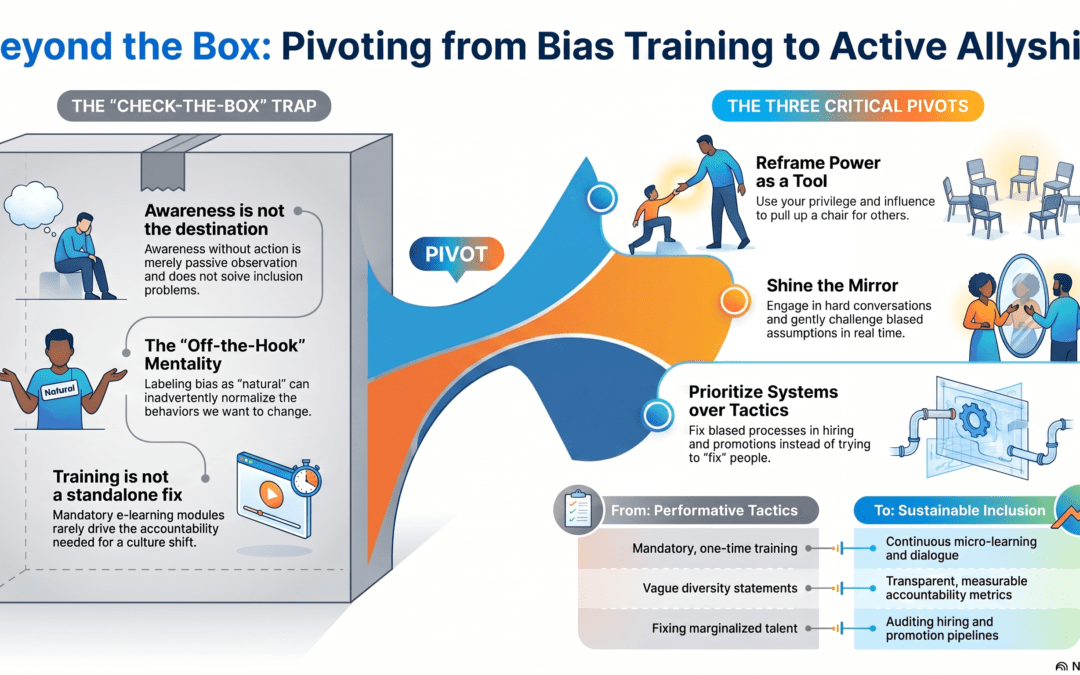
The “Check-the-Box” Trap
When organizations experience a wake-up call—whether it is an employee survey showing low belonging scores or a high turnover rate among diverse talent—the default knee-jerk reaction is to schedule a training session. Don’t get me wrong; awareness is a necessary first step. We cannot fix what we do not see. But awareness without action is just passive observation. When you treat unconscious bias training as a one-and-done checkbox exercise, you inadvertently give people a pass. Employees leave the room thinking, “Well, everyone has bias, it’s just how the human brain works, so I guess I’m off the hook.” Instead of driving accountability, it normalizes the very behavior we are trying to change. Inclusion is not an educational destination. It is a daily, intentional practice.
To move your team past the limits of basic bias training, leaders must make three critical pivots:
1. Reframe Power as a Tool for Others
Leadership is about courage over cowardice. If you have a seat at the table, your job isn’t just to enjoy the view—it is to pull up a chair for someone else. Allies use their emotional capital, influence, and privilege to advocate for those whose voices are systematically minimized or left out of the room entirely.
2. Practice Shining the Mirror
True allies don’t just have fluffy, comfortable conversations. They are willing to engage in the hard ones. Shining the mirror means gently but directly challenging a peer when they make a biased assumption or interrupt a colleague in a meeting. It means establishing psychological safety so your team feels safe enough to give and receive constructive feedback in real time.
3. Establish Purposeful Systems over Performative Tactics
Biased people don’t create systemic inequality all by themselves; biased systems do. If your hiring panels, promotion criteria, and performance reviews are vague, bias will fill the gaps every single time. We need to stop fixing the people and start fixing the processes.
What Sustainable Inclusion Actually Looks Like
To build a culture where everyone can thrive, we have to look past the training calendar and embed inclusion into the organizational DNA. Instead of bias training, pivot from:
- Mandatory training to continuous micro-learning and active allyship dialogue
- Vague corporate diversity statements to measurable, transparent accountability metrics for leadership
- Fixing historically marginalized talent to actively auditing hiring pipelines and promotion processes for equity
The work never stops. I often tell audiences that the good news is you can absolutely learn how to be an inclusive leader. The bad news? The work never stops. There is no graduation day for diversity, equity, and inclusion. If your organization is relying on a single training program to overhaul its culture, it is time to pivot. Stop checking the box and start doing the messy, courageous, and deeply rewarding work of daily allyship. Your team doesn’t need another PowerPoint presentation. They need leaders who are willing to stand up, speak out, and change the game.
Your Next Pivot Point
Are you ready to stop checking boxes and start changing systems? The future is inclusive, and you don’t want to be left behind as a future leader. That is why I offer free allyship training for you and/or your organization by subscribing to our weekly, no-spam newsletter. You can catch new thought leadership in my Allyship in Action podcast interviews, too.