With special guest, Sona Khosla
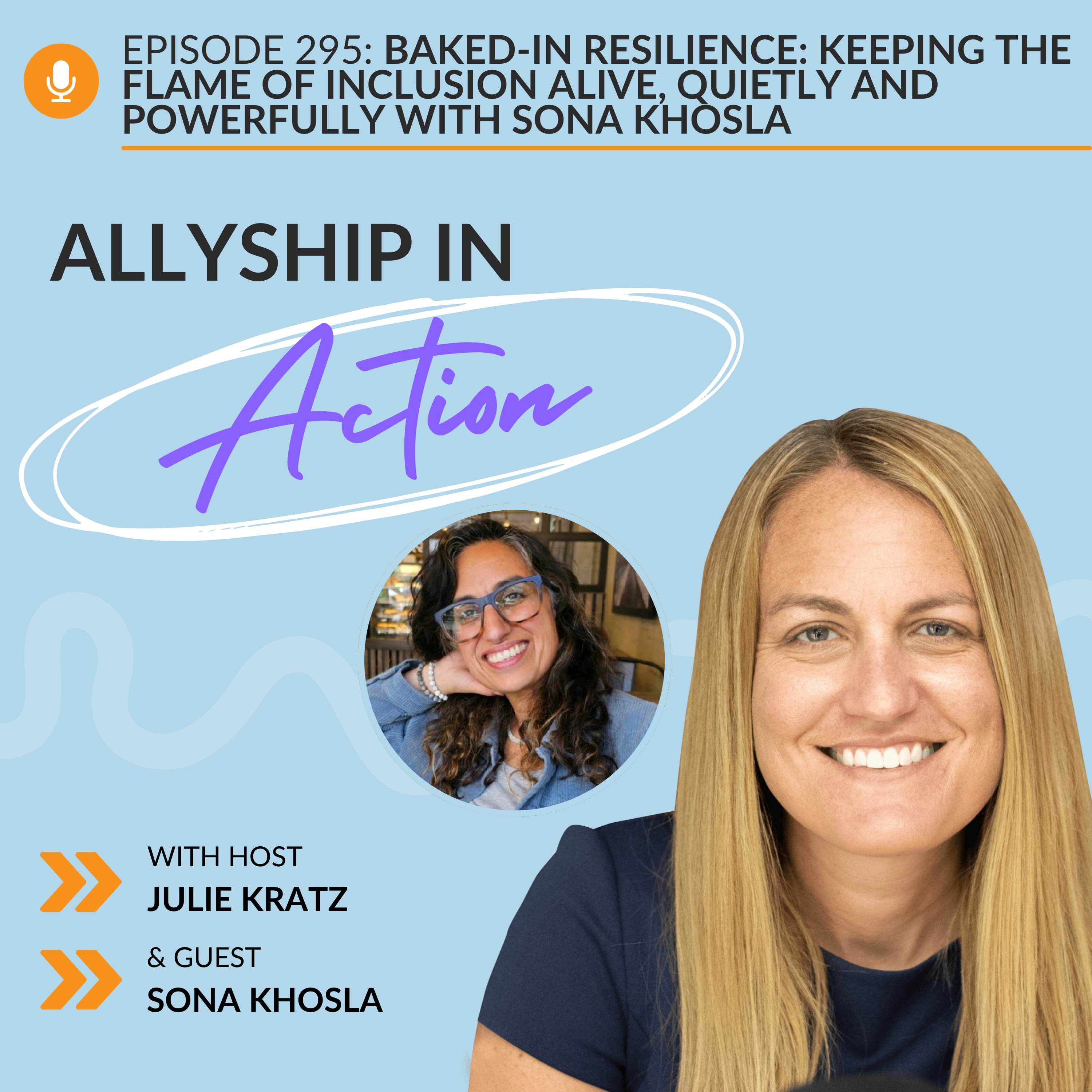
This week on the Allyship in Action Podcast, Julie Kratz is joined by Sona Khosla, Chief Impact Officer at Benevity. Inclusion is about having resilience and courage to keep doing good when it feels like the world’s spinning the other way. And that’s exactly what Sona and Julie dove into this week – this idea that even when the news is full of noise and doubt, there’s a powerful current of good still flowing, quietly and persistently.
Listen Now:


Resilience and the flame of inclusion is still alive
This week on the Allyship in Action Podcast, Julie Kratz is joined by Sona Khosla, Chief Impact Officer at Benevity. Inclusion is about having courage to keep doing good when it feels like the world’s spinning the other way. And that’s exactly what Sona and Julie dove into this week – this idea that even when the news is full of noise and doubt, there’s a powerful current of good still flowing, quietly and persistently. It’s about finding that inner strength, that “baked-in cake” resilience, and reminding ourselves that this work, this striving for inclusion and impact, it’s not a trend, it’s our DNA.
Sona discusses her journey into corporate social responsibility (CSR) and the current state of DEI work. She shares about her initial lack of awareness about CSR and her discovery of Benevity, a tech platform that helps companies engage in philanthropy and social impact initiatives.
She expresses her passion for this work, viewing it as a way to serve others, promote justice, and recognize the interconnectedness of humanity, drawing upon influences from figures like Nelson Mandela and Eastern religious philosophies.
The conversation acknowledges the significant pressures currently facing DEI work, including challenges stemming from the pandemic, economic instability, and social justice movements.
Key takeaways from this conversation:
- The Quiet Persistence of Impact: Despite the noise and pushback, many companies are quietly increasing their investments in CSR and DEI initiatives, recognizing the long-term value and employee expectations.
- Data-Driven Advocacy: The importance of leveraging data and metrics to demonstrate the ROI of inclusion and impact initiatives, moving beyond emotional appeals to tangible business benefits.
- The Long Game of Legacy: Focusing on the enduring impact and legacy of leadership, rather than short-term reactions to current pressures, emphasizing that this work is about long-term human connection and value.
- The Power of Small, Consistent Actions: Emphasizing that even small, consistent actions, like internal communication and employee listening sessions, can make a significant difference in maintaining a sense of belonging and commitment.
- Generational Values Driving Change: Highlighting the influence of millennials and Gen Z in shaping workplace values and consumer expectations, reinforcing that inclusion is not a passing trend but a fundamental shift.
Actionable Allyship Takeaway:
Start a conversation. Even if your company seems quiet on DEI, initiate a lunch-and-learn or team discussion about the data and trends shared in Sona’s research. Talking about it, even in a small group, reinforces that these values matter and builds a sense of community.
You can find Sona and check out her following resources:
- Sona’s LinkedIn: https://www.linkedin.com/in/sonakhosla/
- Benevity’s research: https://benevity.com/impactlabs
- Benevity’s resource hub: http://benevity.com/leadwithpurpose
- The Executive CSR report: https://benevity.com/the-executive-csr-report
Find Julie at https://www.nextpivotpoint.com/
Read more about this topic and our interview in Forbes.
Full Episode Transcript Available Here
Speaker 2
All right, listeners, so excited to have with us today, we have Sona coleslaw. And Sonia is an amazing resource. She works at Benevity and as the Chief Impact officer, and she’s going to share with us some new data, some new research that. Came out and uh, what? The future holds for this important work. Welcome, Sona.
Speaker 1
Thank you so much for having me, Julie.
Speaker 2
Well, tell us about your I always love starting with kind of everyone’s personal story. What brought you into this work and what you’re seeing nowadays?
Speaker 1
Yeah, I guess I’d describe my story of getting into this work is a bit of a. Series of accidents. Maybe that’s how most lives unfold, but you know, I was back in university. I became obsessed with reading the stories of some of, you know, the great, you know, global change. Makers like Nelson Mandela and Mahatma Gandhi and Maya Angelou, and was just so inspired by their work. But you know, it really didn’t shape my career until about 10 years ago, when I joined Benevity because I did a communications degree, got into kind of, you know, PR, comms marketing brand. And you know your career just kind of takes over and you kind of follow the current of your career and you just keep going from role to role. The role, and I mean I found myself in a number of mission driven companies, but I ended up getting laid off at a company that I loved and then discovered this company, Benavidez Y and. Learned what they did and I I didn’t know that corporate social responsibility was a thing. I thought CSR was like a customer service representative. That’s how naive I was at the time. And I heard about this company that enabled that built a tech platform that helped other companies do good in the world through. You know enabling Grant making and scholarships and sponsorships, but also in engaging their employees and doing good through giving donations, matching, volunteering, taking positive social, environmental action. I was like. This is something I want to be a part of and what I found there was that I discovered what I I describe as the best people at the best companies doing the best work and you know, really making capitalism the great. The great thing that we all want it to be and you know, directing resources from companies. To make the world a better place. And so I just kind of felt like I found my people. And I’ve realized that actually, it’s almost like coming full circle back to those books that I read, you know, people who are in this work to really serve and to. To bring about the justice that we all have a right to to bring about the the rights of people and enabling them to live their lives to their fullest potential. And so, yeah, I I just fundamentally believe that this work is actually metaphysical. To some extent, Julie, it’s not just that, you know, people deserve things. It’s that we’re also all connected and that what we do to others we do to ourself. Bills and you know, it’s just this is a common belief in eastern religions. I come from a Hindu background, but also indigenous ways of knowing like we’re just all connected. And so it’s just the right thing to do, is to take care of each other. And so in this moment, I definitely feel like this work is. Under significant pressure, I mean I’ve. I’ve been in this space for 10 years. You know, and I’ve seen it through a number of different cycles through, you know, through the pandemic, through economic volatility through, you know, mass layoffs through, you know, through social and racial justice movement of 2020 and like, but this what we’re in now. Feels like the worst, to be honest.
Speaker
I agree.
Speaker 2
I agree 10 years too, and I’ve never seen it like this and I wanted to be in complete denial about it. Being naively optimistic, like, no, no noise, noise. Put my headphones on. Just keep doing the work.
Speaker 1
Yeah.
Speaker 2
And I think so. Thanks for that summary. What brought you into the work and even in this critical moment, right, our voices can’t be silenced. And that’s something they can’t take away from us. And and it’s really powerful to share the, you know, optimistic side or the real side or in your case data. And versus whatever it takes to show we’re not going away. You can’t stifle this work. I mean, you can really make it difficult, which we’re seeing, but it it, it’s not going to go away. There’s just too many people that care about it like you.
Speaker 1
Yeah. And and it’s just how it it is, the nature of progress, we will progress, we’ll take steps back, but we will progress. I fundamentally believe that resistance is a part of progress. And so that’s what we’re facing. And I can’t not do this work. Right now, right. And so, as exhausting as it can be, people like us. Julie, just. Called to it this. Is what it’s all for, and if not. Now when right?
Speaker 2
Yeah, like what else do you want me to do? I don’t know. How to do? Anything else? Well, then I could, but I don’t. Think anyone would want me to?
Speaker 1
You know Julie? There’s we’re not the only ones. Like, I mean, I’m sure you’ve been talking to people. I mean, you talk to people every week and you see people in this space. I think if I can bring some scale to that discussion like I can share some of the data that we’ve been seeing at benevity. And so I’ve benevity we all little spin off a social innovation lab called Benevity impact labs. And there we just study research and data around what’s happening in the impact and inclusion. So that we can help you know, primarily companies activate on it more effectively. We see as companies as great catalysts in the world for driving positive social and environmental change. And you know, we’ve been looking at the data around how companies are in this environment and you know, you might be surprised to hear that 76% of CSR corporate social responsibility leaders are saying that they’re going to increase their investments and in the next year. And so that is, I think they’re they’re putting their money. And their investments on this work? And when you drill down a little deeper and you ask, OK, why you know, of course there’s a, you know, there’s a moral imperative that many of us are driven to, but there’s actually a business imperative when we look at the top reasons that they’re doing this work, it’s ROI for the business. They know it drives value. They know their consumers expected of them. And their talent, their employees expected of them. And so they’re doing this, you know, for business reasons, recognizing that there is a great social benefit as well and balancing kind of the profit and purpose mandate of of companies today.
Speaker 2
Yeah. Yeah, that is so interesting. Increasing the investment at a time when we’re hearing quite the opposite narrative in the news cycle and maybe even bumblings of and all the conversations like you said, conversations I’m having with folks. Because we’re led to believe that this works on pause or, you know that are legal review. I’ve heard all sorts of things on this. I’m curious. And the one thing I’ve seen in the data and even 2024 data is kind. Of used this at this point. To be like 2025 and we’re so early end of. The year still. No, we don’t have as much data, so that’s why I really love your report is companies are doing the work, but they’re a lot quieter about doing the work. What are you hearing in that regard?
Speaker 1
We’re yeah, we’re definitely hearing that that trend as well. So when we look at where they’re investing, you might be surprised here. But the top area is employee resource groups followed by employee volunteerism and then followed by developing ethical practices around AI. So they are what we’re hearing when I talk, when I get on the phone with our corporate clients and talk to these leaders. They’re saying we’re just figuring out how to continue the good work. All we want to do is continue the good work. We don’t want to target on our backs, so we’re we’re monitoring exactly how much you know we want to be that poppy standing up in the field right now. But there. But you know, there’s a number of companies that I’ve also spoken to have said. This is in our DNA like it’s not going anywhere. Like we have committed to this over the long term. We have been employee driven. We’ve been employed, power empowered and so we’re not going anywhere and it’s been interesting to me because I’ve been watching the news and Benevity has a number of Fortune 1000 companies and our client base of course they can’t. Talk about who all the all of them and who they are, but when I see some of their names show up in the media and some of them are, you know, under the under the label of they’re doing roll. Tax. And I know the work they’re doing and. I’m. Like that, I wouldn’t consider what they’re doing a rollback.
Speaker 2
Exactly, yes.
Speaker 1
I would. I would. No. Interesting. It’s like, no, they’re actually, yes, they’re being a little more quiet about it, but they’re actually investing in their people right now, way more thinking about how to support their employee resource groups, their communities that, you know, underrepresented people and and and even when they say that it’s seen as stepping back. And I think we have this challenge. In our space. Or, you know, if you’re not talking about it, you’re seeing is not doing it. And I think those two things are very.
Speaker 2
I agree. I agree. Yeah. There’s some household names our listeners would recognize that we can both talk about that are doing the work. And not. Being boastful about it, like to your point about being the tall puppy poppy, you know, the tall poppy flower? Yeah, Poppy in the field. I wanted to make sure.
Speaker 1
The poppy in the field.
Speaker 2
I got it right, so that’s good. I’ve been using the analogy to your point about embedding it into your culture like it’s in our DNA. The analogy that I got, and this is mostly from my students because I teach at a university class, they said, I don’t think they understand like this is who we are. You can’t legislate inclusion out of us. So the metaphor that came to me is like a cake that’s already been baked. Like you’re not taking the sugar. And it’s like in there, it’s baked in there.
Speaker 1
Well, that’s the thing. And I like I I I mean we often talk to our clients and they know it. They’re like we look at our talent. If we don’t do this work, we’re going to face employee activism like we’re going to face a demand that, you know, we we live our values and their values like it’s just and.
Speaker
That.
Speaker 1
But I I think in but just back in September, right, we hit the tipping point of where there’s more millennials and Gen. Z in the workforce than there is any other generation it’s like. They’ve grown up with this. That’s who they are. It’s exactly right. And so and they’re the ones who define the market. Ultimately, I think shareholders react to them because they’re the buyers. They’re the decision makers. So, you know, even with all this shareholder activism, I’m like, you’re not like, it’s not making a ton of sense in terms of.
Speaker 2
Great.
Speaker 1
If your if your job is to actually protect the business. Then you know you would really look at investing in these areas because that’s where the markets going like the purchasing power by 2035, that Gen. Z is gonna hold like their values are gonna change. They’re gonna stop caring about the environment or stop caring about human rights like.
Speaker 2
Yeah. Is there? Yeah. It’s only going to strengthen, right? Especially with these unnecessary pressures that are being put on.
Speaker 1
That’s the opportunity for business, I think.
Speaker 2
Yeah. It’s it’s a great business application that you just shared too, like shareholders are reacting to younger consumers keyword, they’re reacting right and inclusion. I’ve always tried to frame it as like insurance. It’s being proactive. If you’re not working on it. Inclusion, whether that’s your employee resource groups or their cultural initiatives or just like you said, baking it, you know into the. Cake it’s. You’re you’re the risks far outweigh like of of not doing it, of of doing the work. I mean, lawsuits, discrimination claims turning over. I mean, you and I could go. On. And on. But there is this. Like knee jerk reaction this. Instant kind of withdrawal. OK, we’re not supposed to be doing this. Oh, gosh. We could get attacked by this new administration and I. Get it? I get. It for business leaders, it’s it’s it feels risky. But you know, we’re really asking for courage over cowardice right now. I think from leaders. And so I’m just curious, you know, a lot of leaders that are learning into that courage, even if they’re doing it quietly, that’s great. Just do the work. I don’t. I don’t need you to talk about it. Right. Just do it. But what do you think it takes at this moment in time for leaders to really engage in a time when they might feel quite conflicted?
Speaker 1
Yeah, I think it’s a such a good question, Julie, because I think they’re we’re living in like a soup, right? We’re all in this psychic soup and there is so much fear in the soup that I think what it’s taking right now is for people to say. OK, I acknowledge that there is risk like significant risk in the system right now. But what is it? What is? What is the risk of inaction, which is what you pointed out? What’s the risk of inaction and what do I know for sure that will be enduring? I think that is the most important thing. Like in these moments, like when I look back in the 60s, Seventies, 80s and you look at these.
Speaker 2
Exactly.
Speaker 1
Movements, they’ve, they’ve, they’ve gone back and forth, the pendulum has swung, but staying steadfast got marriage equality rights, women’s rights right? Like you know, all of the equity that we see now. So. I think thinking about what is enduring the thing I think about as a leader in this space every day is in 10 years I want to feel like I can still proudly say that here’s what I did. I want to be proud of what I did, and so I’m thinking long term, that’s where the most more enduring. The other thing is. What we’ve learned in our data is that a number, while the majority of business leaders who do this work say they’re doing it for business value, it is shocking the number of business leaders that don’t actually have measurement or metrics.
Speaker 2
You know.
Speaker 1
And that, I think is an Achilles heel in this space. And so that’s partly why the data is so important. Important so you know it’s it’s it’s almost half don’t have measurement or metrics. So that’s partly why we’re trying to advocate with data and say OK, like we you know we released a study you you you referenced retention we released a study back in 2022 that showed that newer employees who engage in giving and volunteering through their companies or 52%. Less likely to leave, you know we have data right now that shows that your Glassdoor ratings will actually be higher if you are have higher participation rates in these programs because it has a has. Will affect on your purpose your values, how your perceive your CEO because you know they’re they’re advocating for these programs. So that kind of data is really critical because I think if you show up emotionally and morally, you’re actually likely to alienate business leaders, especially in the risk legal and financial. You know, areas who who were.
Speaker 2
When it gets into like quote UN quote listeners, identity politics or you know, somehow it’s like US versus them, I mean it’s those are tricky waters like just stick to the basics like you said like what are the measurements, the impacts to the business and. So and I love what you said too, because I I literally have a writing writing on my wall, but I went through some therapy craft language around this and it’s very important, right? Now. Mental health is literally what you said about the long term. It’s about legacy. Is this legacy work and what kind of legacy do you want to let leave leader leaders right? Like what is your leadership legacy? And these are the nuts and bolts of that. You know, when people are in their final times on the planet, they don’t say they wish they worked more or made more money. It’s just so rare that someone would say that maybe there are some people that I won’t even won’t even mention who those people might be. But. Most people like, gosh, I wish I’d had more of an impact. I wish I’d. You know, deepen my relationships. I wish I’d spent more time with other human beings that were important to me, and that’s what this work is really about.
Speaker 1
It really is, and the people who gravitate to this space are doing it for that. And so it’s incumbent upon us to bring everybody else in the business along with us and to tap into the individual motivations of those folks like, you can run these programs and mitigate risk. It’s not a binary. You can stand for something but be inclusive, like it’s not a binary. And I think that’s the other pieces. I think you know you referenced kind of the US and them thing, it’s like it can’t. It can’t be that. And in fact this work isn’t that it isn’t about. Saying 1 is better than the other, it’s it’s really around breaking down those binaries and saying actually we’ve got a lot more in common than we don’t and that everyone deserves a chance no matter what their background, experiences and abilities are, and paving the way for that. It was really interesting. A few years ago, we released a study that was all about kind of the state of workplace DI. And it’s a, you know, it’s over 90% of employees said that they had benefited from a DUI program.
Speaker 2
I referenced that statistic all the time. It’s. 90% mean where else in your business do you get that?
Speaker 1
Where else do you get that? And like that goes to show diversity programs are not for just the minority of populations that actually when you design your systems for all like you benefit all. And more people than you’d ever expect, sometimes by solving a problem over here, you solve a problem for all these other people over here. And that’s what I think is so powerful about this work is when you start to think about my experience is not the only experience. But for example, I don’t have children, but I have. And I have older parents. So as caregivers, we have similar things. So if we can solve for B. Health we’re we’re actually hitting a majority of our employee population. And so I. Think that that’s that just never ceases to amaze me because it’s it just goes to show that we all we all benefit from these programs.
Speaker 2
Yeah. The the good old analogy rising tide lifts all boats and there’s so much evidence of that. When I think about things that benefit disabilities, we wouldn’t have text messaging, right, like closed captions. Like all of these things, it’s not a binary, it’s it’s really for, for all of us, it’s true. Inclusion benefits everyone.
Speaker 1
Yeah, I can’t. I only. I only watch closed captions now, like when I’m in public all of my. Videos are on mute and. I’m watching the clothes like. It’s so fun.
Speaker 2
Yeah, same same. I love. I’ve. I’ve gotten into British television recently because of their accents from the closed captions, and that just doesn’t benefit one group. It benefits so many other groups. And yeah, that’s that’s the heart of inclusion. Well, I know you.
Speaker
Yeah, exactly.
Speaker 2
On the forefront of research in this space are there new projects you’re working on, things that you’re excited about now?
Speaker 1
Yeah, I mean, we have our newest report coming out in May. So state of corporate Purpose 2025 is coming out. And I can tell you there’s some very interesting trends in there. Julie, we might have to have. Another conversation about that. But you know one thing I will say is a lot of the data is showing us that. UM. We track data on courage and caution within companies and we’ve been tracking, so this will be the third year I think that we’ve tracked it and I’ll just say like we are seeing such a strong appetite for courage and yet we’re so cautious in our approaches right now. And I think. There’s an opportunity for us to bridge. That, and I think it’s going to require non binary thinking kind of what we call it and every the power of and how can you do this and do this and really creative thinking and I think people in our space proved that in the pandemic and the racial justice move to 2020, we can be creative, we can be agile, we can be adaptable. And so I’m I’m quite. I’m quite encouraged by how much people want to see courage. What I’d say is it’s up to us to bring the solutions to the table around how we can execute. It it, I think companies are being slow right now to react and I understand why. There’s a lot at stake, but I would encourage people to take small steps and experiment. You don’t have to make big moves right now, like even testing how you post things on social media or. You know how you communicate internally what’s resonate. Getting tapping your DRG’s, finding out how they’re feeling. What are the small things you can do to make sure that they know that they still belong, that they’re cared for, and that they are benefit to the company and to keep, you know, keep contributing their unique experiences. So there’s so many small actions we can all take in.
Speaker
Yes.
Speaker 1
Our day-to-day. To continue this.
Speaker 2
Work. Yeah. Yeah, I I can speak to that personally. Participated it in a lot of. Facilitating, you know, listening sessions nowadays and getting a pulse of employees and the number one thing I’m taking away from these conversations is that they want. Companies to say not externally. More importantly, internally, that’s what employers care about. They want to hear the commitment. Yeah. Hey, we’re still committed. All you have to say is we’re still committed to inclusion even if you’re working. The attorneys are reviewing it, which we have a whole another podcast on the legalities and the falsehoods around the. Even if you were hitting pause right now. Echoing your commitment to the work long term and figuring out what it looks like long term is totally fair. Every business strategy gets updated and rebranded pivots. Of course, this is no different, but not saying something not and just hitting pause and not saying anything is very dangerous. And I expect organizations will be held accountable for that, and you may not feel it today. You may not feel it tomorrow, but you and I know the long game you’re out.
Speaker 1
Amen, sister. Well, we’ll have.
Speaker 2
To feature that the next report, this is so fun and listeners all linked to the most current report on some of those fascinating findings and nothing else.
Speaker 1
You know it.
Speaker 2
Even if your organization isn’t talking actively about these things, or even if you don’t have employee resource. Groups you know. Download copy of the report, have a lunch and learn a conversation with your team. If you’re a manager. Hey, what do you think was interesting? That is, of course legal, of course. It should not be controversial at all. This is data to our business. Let’s just talk about it.
Speaker 1
Yes. Exactly because everyone this is dinner table talk right now. So how rare is it that these topics are at every single dinner table right now? And so, of course, it’s on people’s minds. So I think acknowledging that reality and engaging in the conversation in a way that’s just providing people with the platform. Content you know to share their views and their experiences could be deeply unifying, which may be exactly what we need right now, yeah.
Speaker 2
Yeah, it’s humanizing. Getting to know people as human beings, not. At your dinner table, we can bring it to the. Lunch table too. Thanks Sona for your great work. I’m telling where can they follow Benavidez’s latest research and get the scoop?
Speaker 1
Yeah, absolutely. So I actually post data weekly on my LinkedIn so people can follow me on LinkedIn, Sona, Khosla, and and benevity.com benevity.com/impact Labs. You can find all of our research there. Hopefully it’s a it’s a great resource for for leaders in this work to be able to find the. Data to advocate and evangelize for this. Work as well. We just recently launched a a resource hubthatsbenevity.com slash. I believe it’s lead with purpose. I’ll give you the link for the show notes Julie. And we’re going to be updating it consistently to just support, you know, leaders, managers, individuals who are in this work through this moment. So that we can all come out the other side and feel proud of the. Legacy we’ve left.
Speaker 2
Yeah, I love all that. So good. We’ll keep up. The amazing work. Stay strong and thanks for your voice in. The world Senna.
Speaker 1
Right back at you, Julie. Thank you.
