
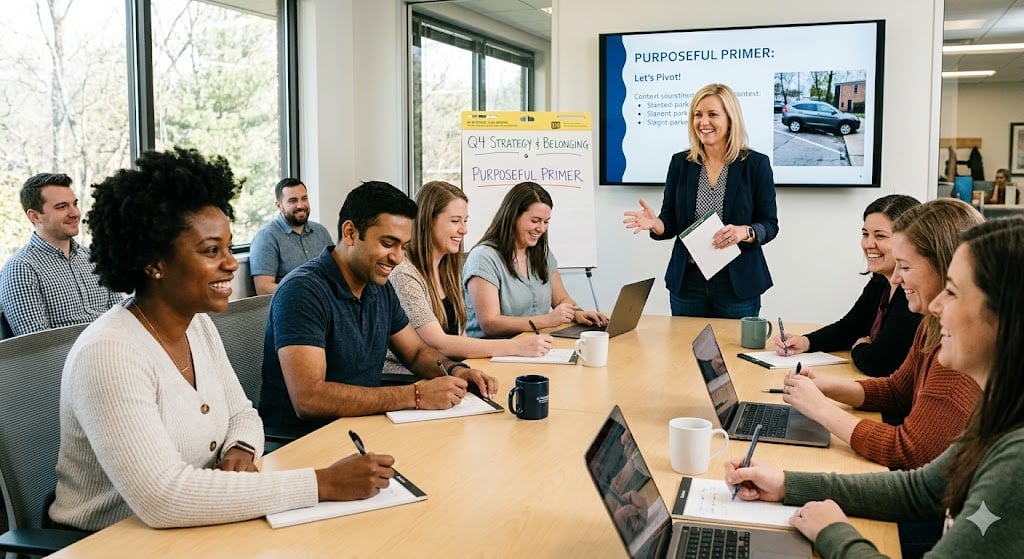
What is a purposeful primer?
They are distinct from icebreakers. I used to start client facilitations with icebreakers like “If you were an animal, what would you be and why?” I am embarrassed to admit it, but I finally picked up on the awkward glances and lack of participation, and abandoned icebreakers altogether.
But, without an opening warm activity, I lost out on some chemistry and priming for discussion. Thus, the need for a purposeful primer.
Meetings are a snapshot of culture. Every minute we spend together in a meeting is an opportunity to foster inclusion—or unintentionally erode it. While the intention behind traditional icebreakers is usually good (we want people to connect), they often miss the mark.
Instead of breaking the ice, they tend to freeze people out. That is why it’s time to retire the standard icebreaker and pivot to what my friend and ex-Google leader, Kelsey Kates, calls a Purposeful Primer.
A Purposeful Primer is a deliberate, low-stakes, high-connection prompt that takes just the first three minutes of your meeting. But unlike an icebreaker, it serves a strategic purpose. Here is how you can make the switch in your next meeting, broken down into three essential steps.
1. Not Cringy or Forced
Traditional icebreakers often put people on the spot with highly personal or bizarre questions. For an introverted team member, someone from a different cultural background, or someone who doesn’t feel safe sharing their life story with colleagues, these moments can feel forced and cringy. They can actually trigger anxiety rather than reduce it.
An inclusive meeting requires psychological safety from minute one. A Purposeful Primer lowers the stakes. It isn’t about performing or trying to be the funniest person in the room. It’s about a gentle entry point into the conversation. Instead of forcing vulnerable sharing before trust has been built, a primer meets people where they are. It’s simple, accessible, and gives everyone an equal, non-threatening runway to unmute and share their voice.
I personally love using Brene Brown’s two-word emotional check-in exercise if I am struggling to come up with one for the specific meeting purpose.
2. Tied to the Topic
The biggest differentiator of a Purposeful Primer is that it isn’t random. If your meeting is about Q4 budget cuts, asking people about their favorite childhood vacation feels disconnected and tone-deaf.
A primer is intentionally tethered to the work you are about to do. It prepares the brain for the specific context of the meeting. For example, if you are hosting a workshop on unconscious bias, empathy, or adapting to organizational change, your primer should subtly introduce those themes. By aligning the opening activity with the meeting’s core objectives, you aren’t just filling time—you are shifting everyone’s mindset into the right gear.
3. Facilitator Demonstrates with Examples
As a facilitator, you cannot just throw a prompt out there and expect people to jump in. You have to model the behavior and demonstrate the concept first. This is where you can use quick, physical, or visual exercises to illustrate your point and get people engaged.
Here are three quick examples you can use to model a primer, depending on your topic:
-
Right-Hand vs. Left-Hand Writing: If your meeting is about leaning into a new strategy or navigating change, ask everyone to grab a pen. Tell them to write their name with their dominant hand. Easy, right? Then, ask them to switch to their non-dominant hand. It feels awkward, slow, and uncomfortable. As the facilitator, you share your own messy handwriting and say: “See? Change feels clunky at first, and that’s exactly what we are navigating today as we roll out this new process.”
-
Looking Up/Down, Right/Left, and Switch: If you’re talking about shifting perspectives or biases, have everyone look up, then down, then right, then left. Now, tell them to do the exact opposite of what you say (if you say “up,” they look “down”). When people inevitably mess up, laugh with them! You’ve just demonstrated how hard it is to break automatic cognitive patterns—a perfect setup for a discussion on unconscious bias.
-
The Slanted-Parked Car Empathy Pics: If you are building a meeting around empathy or team collaboration, share a photo on your screen of a car parked horribly over the line, taking up two spots. Ask the team for their immediate reaction. Most will say, “That driver is selfish!” Then, show a second picture or offer the context: what if the previous car had been parked slanted, forcing this driver to park that way just to fit? By sharing this visual, you demonstrate how quickly we jump to judgment without seeing the full picture—priming the team to practice deep empathy during the tough conversations ahead.
Meetings that lack a clear, inclusive runway often result in the same dominant voices taking over. By starting with a Purposeful Primer, you set the ground rules for engagement, level the playing field, and ensure that everyone feels seen and heard right from the start.
Your Next Pivot Point
Are you ready to stop checking boxes and start changing systems? The future is inclusive, and you don’t want to be left behind as a future leader. That is why I offer a free allyship training for you and/or your organization by subscribing to our weekly, no-spam newsletter. You can catch new thought leadership in my Allyship in Action podcast interviews, too.